
Artificial Intelligence in Marketing — Where It Genuinely Helps Companies

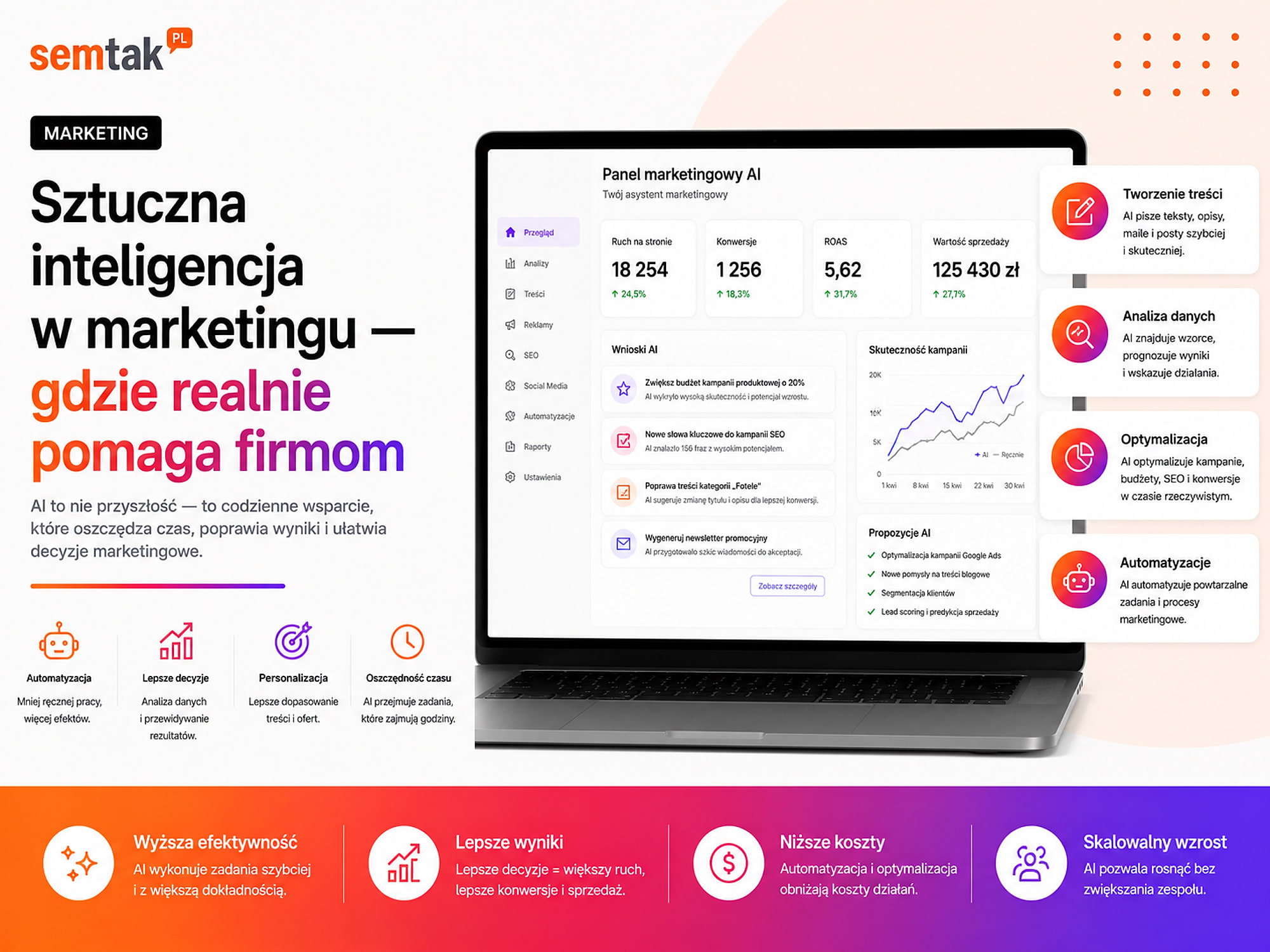
Artificial intelligence can draft an article, summarise campaign results, sort leads or answer common customer questions in a matter of minutes. It is impressive, especially when a similar task used to take an employee several hours.
The problem starts when a company expects that simply buying access to an AI tool will automatically improve sales. The model does not know the company's real costs, does not understand every exception in a process, and can present false information in a very convincing way.
AI genuinely helps where a task is repetitive, has defined inputs and where the quality of the output can be checked. The best results appear not when the model "does marketing", but when it takes over a specific part of the work: analysis, classification, preparing a first draft or handling a simple enquiry.
This article is an overview of AI use cases in marketing. It shows where the technology can help, while the detailed design of workflows, integrations and automation is covered in separate materials about process automation.
In short
Artificial intelligence genuinely helps companies above all with:
- Analysing documents, reports, reviews and conversations.
- Preparing research and first drafts of content.
- Creating variants of ads, headlines and messages.
- Classifying leads and customer enquiries.
- Handling repetitive questions through an assistant backed by a knowledge base.
- Personalising communication and product recommendations.
- Spotting anomalies and patterns in marketing data.
- Automatically preparing reports and summaries.
- Tidying up product data in e-commerce.
- Connecting marketing with a CRM, store, email and the company's systems.
AI should not, without supervision, publish content containing facts, send individual sales offers, respond to difficult complaints, make decisions of major importance to the customer, work on confidential data without agreed rules, increase advertising budgets on its own, or replace strategy, measurement and human oversight.
The safest model: human-in-the-loop
Human-in-the-loop is a process in which AI performs a defined task and a person checks or approves the result before it is used. The model speeds up the work, but responsibility for a publication, an offer or a reply to a customer stays with the company.
In a nutshell (TL;DR)
- AI works best as an assistant for a specific task, not as an "automatic marketing department".
- It delivers the most value in analysis, classification, summaries, drafts and handling repetitive processes.
- AI-generated content needs fact-checking, brand-tone checking and alignment with the real offer.
- AI-based ad campaigns still need correct conversions, good materials and budget control.
- A chatbot should answer based on an approved knowledge base and be able to hand the conversation over to a human.
- Automation and AI are not the same: automation carries out steps, while AI helps make sense of ambiguous text, a document or a question.
- Do not pass confidential data to a random tool without checking its storage and data-use rules.
- Start your rollout with a single measurable process, not by buying lots of apps.
What does artificial intelligence in marketing actually mean?
The phrase "AI in marketing" covers several different types of technology.
Generative models create or process text, images, audio, video, code, presentations and summaries. This group includes, among others, the language models used in popular AI assistants.
Classification models assign data to defined categories — e.g. a valuable or accidental lead, a sales or technical enquiry, a positive or negative review, a product belonging to a specific category, an email that needs a quick response.
Predictive models try to forecast future behaviour based on earlier data — they can help estimate who is likely to buy, which customer might leave, which products may sell together, when demand will rise and which lead has a higher chance of converting.
Recommendation systems match products, materials or messages to a user ("Customers also bought", recommended products based on history, articles matched to interests, the dynamic ordering of elements on a page).
Ad-platform algorithms. AI has for years also worked inside advertising systems — it helps, among other things, set bids, choose placements, match audiences, predict the probability of conversion, combine ad variants and allocate the budget.
For a business owner, more important than the type of model is the answer to the question: which specific task can be done faster, more cheaply or more accurately?
AI, automation and marketing automation — how do they differ?
These terms are often lumped together.
| Solution | What it does | Example |
|---|---|---|
| AI | Analyses, classifies or generates a result | Recognises the topic of a message |
| Automation | Carries out predefined steps | Creates a task in the CRM |
| Marketing automation | Reacts to a contact's behaviour | Sends a sequence after an offer is downloaded |
| Integration | Passes data between systems | Form → CRM → email |
| AI automation | Connects a model with a process and systems | AI classifies a lead and the system assigns it to a salesperson |
Example without AI: a customer submits a form → the data automatically goes to the CRM → a salesperson gets a notification. That is automation, but not necessarily artificial intelligence.
Example with AI: a customer sends a description of their need → AI recognises the service, the industry and the urgency → the system assesses whether the enquiry is complete → the lead goes to the right salesperson → AI prepares a draft reply → a person reviews the message and sends it. In this case AI handles the ambiguous text, while automation moves the data and carries out the next steps.
If you are mainly interested in the flow of leads, emails and data between systems, read the guide automatyzacja marketingu dla firm — co realnie automatyzować.
Where does AI genuinely help in marketing?
1. Research and organising information. AI is good at analysing large amounts of text — it can help collect and organise product documentation, call transcripts, customer surveys, reviews, service tickets, competitor materials, meeting notes, sales reports and questions from the support team. Example: a store has 800 product reviews. Reading every review by hand is possible but time-consuming — AI can pre-sort the reviews into themes (build quality, assembly problems, colour accuracy, delivery, missing information in the description, damage, the most frequently mentioned strengths). A human should still check a random sample of the classification, assess the business significance of a problem and decide whether to change the product, the manual or the description. AI shortens the first analysis — it should not decide on its own why customers are not buying or which products should be withdrawn.
2. Content strategy and brief preparation. AI can help prepare a first version of a content plan: grouping customer questions, sorting phrases by intent, creating an outline, preparing questions for an expert, pointing out missing topics, comparing several materials, mapping out an H2 and H3 structure and preparing a checklist of sources. A good way to use it: a company wants to write a guide on choosing a mattress; customer-support questions, information from the manufacturer, return data, specifications, the product list and the most common customer problems are fed to the AI — the model helps build the structure (firmness, user weight, sleeping position, material, dimensions, the most common mistakes), and an expert fills the guide with knowledge and checks all the information. A bad way to use it: the instruction "write 100 articles about mattresses" without company data, expert knowledge and quality control — this produces a lot of similar content that adds nothing beyond materials already available online.
3. Creating first drafts of text. This is the most visible use of generative AI. The model can prepare drafts of articles, product descriptions, newsletters, offers, ads, posts, replies to messages, FAQs, video scripts and meta titles and descriptions. The word draft is the most important one here. AI is good at breaking the blank-page problem, creating several variants, simplifying difficult text, changing the tone of communication, tidying up chaotic notes, adapting the format to the channel and shortening or expanding content. A person must check the accuracy of the information, alignment with the offer, prices and terms, product names, deadlines, promises, brand tone, similarity to competitors, the logic of the argument and the rights to the source materials. Example: AI receives the specification of a desk (height range, desktop dimensions, number of motors, load capacity, noise level, colours) and can prepare a technical description, a simpler version for the customer, a parameter table, a proposed FAQ and a short ad copy — but it should not invent the warranty period, certificates, country of manufacture, health effects or the results of tests that were never carried out.
4. Updating and repurposing content. AI is often more useful when working on existing material than when writing from scratch — it can shorten a long report, turn a webinar into an article, convert a manual into an FAQ, prepare a summary of a conversation, create several formats from one piece of material, tidy up an old post, point out fragments that need updating and adapt content for a less technical audience. From a single one-hour webinar you can prepare a transcript, an article, a list of questions and answers, short posts, a newsletter, fragments for an offer and a checklist for customers. AI speeds up the repurposing of material — an expert still has to approve the meaning of what was said and remove errors from the automatic transcript.
5. SEO and visibility in AI search engines. AI can support SEO work, but it does not replace technical analysis or strategy. Practical applications: grouping phrases, classifying intent, preparing outlines, analysing user questions, detecting similar content, creating linking proposals, organising meta data, analysing logs and exports and preparing rules for a large catalogue. Using AI alone does not disqualify content — the problem is producing many pages with no added value. An article should bring something the model alone cannot: your own experience, company data, examples, photos, procedures, tests, expert opinions, specific limitations and comparisons based on the real offer. Terms such as AI Overviews, AI Mode, GEO and AEO concern answers generated by search engines and AI assistants instead of the classic list of links alone — this does not mean, however, that you need a separate set of "magic tricks". The basics still include a site accessible to crawlers, a clear structure, credible information, unambiguous answers, data about the company and its products, your own experience and consistency of information across the web. AI can help prepare the material — the credibility must come from the company.
6. Google Ads and other paid campaigns. AI in advertising systems helps, among other things, set bids, match audiences, create material variants and predict the probability of conversion. This does not mean, however, that a campaign runs itself — the algorithm still needs a correct goal, properly measured conversions, an up-to-date offer, data on sales value, lead-quality control and budget decisions. The full scope of human and automated work is covered in the article prowadzenie kampanii Google Ads — co obejmuje i jak działa. If the problem is incorrect input data, start with the guide konwersje w Google Ads — jak je poprawnie mierzyć. In e-commerce it is also worth checking how AI works within reklamy produktowej Google — Shopping i Performance Max.
7. Creating ad and creative variants. AI can quickly prepare variants of headlines, shorter versions of a description, call-to-action proposals, messages for several segments, graphic versions in different proportions, video cut-downs, an ad storyboard and script proposals. This is useful when a company already has a defined offer, source materials, brand guidelines and knowledge about its audience. AI does not, however, replace a differentiator — the model can produce many correct messages that sound similar to all the ads in an industry ("high quality, professional service and an individual approach"). A genuine differentiator has to come from the company: lead time, proprietary technology, a specific scope of service, the implementation method, a guarantee, availability or specialisation.
8. Campaign analysis and reporting. AI can help translate a results table into a readable summary — comparing periods, pointing out unusual changes, grouping campaigns, explaining basic metrics, preparing a comment for a report, finding campaigns that need checking and combining data from the store, CRM and ads. Example: a system pulls Google Ads costs, the number of leads, CRM data, WooCommerce purchases, category margins and returns each week, and AI prepares a draft summary (cost per lead rose, the number of forms stayed similar, the number of qualified leads dropped, the problem concerns two campaigns, sales of category A grew but the margin fell). An analyst checks the numbers and adds the interpretation. If a company still combines data from several tools by hand, dashboards and reports for companies can help.
9. Customer segmentation and personalisation. AI can help split customers by purchase history, order value, activity, viewed categories, purchase frequency, likelihood of returning, churn risk and interest in a specific offer. On this basis a company can vary the recommended products, the email content, the order of offers, the messages, the promotions and the contact frequency. A new user may need an explanation of the differences, a buying guide and delivery information; a regular customer may expect a complement to a previous purchase, a part that fits a product, a repeat order or an offer for loyal customers. Personalisation should not, however, give the impression that the company tracks the customer's every move — you need to limit the scope of data, set clear rules for its use, control access, allow opt-out and keep a reasonable communication frequency.
10. Email marketing. AI can help prepare subject-line variants, shorten messages, segment recipients and analyse replies. It will not, however, fix problems related to list quality, consents, sending frequency, sender reputation and message deliverability. Technical mechanisms such as SPF, DKIM and DMARC confirm the sender's identity and help protect the domain — they are a separate technical area, and simply generating better text with AI does not replace them. AI should improve how well communication is matched, not lead to sending more aimless messages. The broader communication and sequence process is covered in the guide automatyzacja marketingu dla firm — co realnie automatyzować.
11. Lead classification and scoring. A company can receive enquiries of very different value: a concrete enquiry about an implementation, a request for a price list, a sales pitch, spam, a service ticket, a job candidate, a customer looking for a different service. AI can read a message and assign a topic, a department, urgency, potential value, missing data and the next step. An example process: a form goes into the automation → AI recognises the type of project → checks whether budget, deadline and scope are given → assigns an initial category → the lead goes to the CRM → the system assigns the right salesperson → AI prepares a draft reply → the salesperson approves the message. AI can organise the queue, but it should not automatically delete leads without the option of oversight.
12. Preparing offers and sales replies. AI can prepare a draft offer based on a form, a brief, a message, a call transcript, a service catalogue, a company template and earlier projects — it can fill in a summary of needs, the proposed scope, the stages, a list of questions, assumptions, exclusions and the structure of the message. A person must check the price, scope, deadlines, liability, terms of cooperation, profitability and the promises made. A safe model: AI prepares a draft → the salesperson checks alignment with the conversation → sets the price and scope → removes incorrect assumptions → approves the document. Automatically sending offers with a price without oversight can end in an undervalued quote or a promise of a feature the company cannot deliver.
13. Chatbots and customer service. An AI chatbot can answer questions written in natural language. It works best on topics such as the delivery method, payment methods, order status, return policy, basic product parameters, the availability of documentation, opening hours and preparing for contact with a consultant. A safer assistant uses the company's approved materials (terms and conditions, product descriptions, manuals, price lists, procedures, FAQs, technical documentation) — such a solution can still make mistakes, but the range of answers is better controlled. It is worth handing the conversation to a human for matters concerning complaints, payments, individual pricing, personal data, conflict with a customer, an unusual problem, legal liability, security and financial decisions. A chatbot should not make it harder to reach an employee.
14. Analysing conversations and customer service. After the data has been properly prepared, AI can analyse chats, phone calls, emails, tickets, complaints and satisfaction surveys — it can help detect the most common questions, missing information, product problems, reasons for cancellation, the stages where a customer gets stuck and recurring sales objections. Example: the support team regularly answers the question "is the product delivered assembled?"; AI detects that it appeared in 18 conversations. The right action is not only to prepare a faster reply — it is also worth adding the information to the product page, completing the FAQ, showing it in the cart and improving the delivery instructions. AI finds the problem; the company should remove its cause.
15. Product recommendations in e-commerce. A recommendation system can use products viewed together, products bought together, user history, similar features, seasonality, stock levels and cart value — supporting cross-selling, up-selling, bundles, complementary products and repeat purchases. Example of a good match: a customer buys a desk, the system recommends a cable holder, a drawer unit, a lamp, a mat and a matching chair. Example of a bad match: a customer buys a 160 × 200 cm mattress and the system recommends a 140 × 200 cm bed frame just because both products are popular. The model should take into account hard rules: size, compatibility, variant, availability, category and exclusions. AI does not replace correct product data.
16. Organising the product catalogue. In a large store AI can help classify products, assign attributes, standardise names, detect missing fields, compare descriptions with documentation, recognise similar products, group variants, prepare category proposals and translate draft content. Example: a store imports 10,000 products from several suppliers, and the colour black appears as "czarny", "black", "BK", "czerń", "01 Black", "nero" — AI can propose assigning them all to one value, "Black". The process should, however, include a dictionary of allowed values, exception rules, a control sample, approval of changes and the ability to roll back the import. Otherwise the model may merge items that only appear to be the same.
17. Translation and localisation. AI can speed up the preparation of a first version of the translation of products, categories, ads, messages, manuals and FAQs. Localisation, however, means more than swapping the language — you have to adapt the currency, units, payment methods, delivery, returns, cultural context, variant names, industry vocabulary and legal requirements. Example: a literal translation of "szafka RTV" may not match how customers in Germany or the Czech Republic look for the product. AI will prepare a draft — someone who knows the market should check the naturalness of the language, the terminology, the search intent, the correctness of parameters and the sales messages.
18. Generating graphics, photos and videos. Generative AI can help create graphic concepts, backgrounds, format variants, storyboards, simple animations, vertical versions of videos, product visualisations and material for tests. This makes sense for campaign sketches, idea visualisations, social-media backgrounds, short ad variants, prototypes before a photo shoot and supplementary guide materials. You have to be careful when presenting the actual product, with colours and dimensions, technical features, "before and after" photos, the customer's image, certification marks, health effects and material suggesting a real event. If a generated visualisation shows a piece of furniture that is larger, brighter or equipped with a feature the product does not have, the customer can be misled.
AI in marketing — where it helps, and where a human is needed
| Area | Good use of AI | What stays with the human |
|---|---|---|
| Research | Grouping sources and questions | Assessing credibility |
| Content | Draft, structure, variants | Facts, experience, brand tone |
| SEO | Classifying phrases and content | Strategy, technique, priorities |
| Google Ads | Bids, matching, variants | Goals, conversions, budget, margin |
| Variants and segmentation | Consents, frequency, deliverability | |
| Lead scoring | Initial classification | Final assessment of potential |
| Offers | First version of the document | Price, scope, liability |
| Chatbot | Common questions | Complaints and unusual cases |
| Analytics | Anomalies and summaries | Business interpretation |
| Products | Attributes and classification | Catalogue rules and control |
| Graphics | Ideas and variants | Alignment with product and brand |
| Personalisation | Choosing recommendations | Privacy and communication limits |
Where does AI most often fail?
It lacks the company's data. The model does not automatically know the margin, the strategy, the customers, the constraints, the project history, the procedures or the way things are sold. Without this information it produces a generic answer.
It can make up facts. AI can give a non-existent source, an incorrect rule, a false parameter, an invented feature, an outdated tool name or a wrong price. A convincing style does not mean it is true.
It bears no responsibility. The company is responsible for a published ad, an offer or a reply to a customer. You cannot justify a mistake by saying "that's what the AI generated".
It does not understand the full context. The model may not know that a product will be withdrawn, that the company does not serve a particular region, that the sales department is overloaded, that an individual contract applies, that a promotion has exceptions or that the customer previously filed a complaint.
It averages out communication. Without good data and content editing, AI texts sound similar ("in today's fast-moving world", "of key importance", "a comprehensive solution", "an individual approach"). A company can publish more but sound just like the competition.
Which tasks should not be handed to AI without oversight?
Particular caution is needed with: prices and quotes, contract terms, medical and legal advice, complaints, HR decisions, assessing financial standing, publishing customer data, crisis communications, deleting leads, increasing budgets, claims about product properties and content concerning safety.
AI can prepare supporting material. The final decision should rest with the person responsible for that area.
Company data and privacy — what to watch out for
The biggest mistake is pasting whole customer databases, contracts, financial results, technical documentation, passwords, API keys, medical data, employee data and confidential offers into a random tool.
Before using a tool, check who the provider is, where the data is processed, how long it is stored, whether it can be used for training, who has access, whether you can set retention, whether a data-processing agreement exists, whether the tool has a corporate version or an API, and whether employees use a shared, controlled space.
Data minimisation. Pass the model only the information needed to complete the task. Instead of a full message with customer data, you can pass anonymised content, the type of case, the industry, the scope and removed contact details.
Permissions. Not every employee should have access to all conversations, the entire knowledge base, purchase prices, financial results and management documentation. An AI system should respect roles and permissions just like a CRM or an admin panel.
The AI Act, content labelling and transparency
The EU's rules on AI are being introduced in stages and are based on the level of risk of the use case. For marketing, transparency is the most important aspect.
Depending on how it is used, it may be necessary or reasonable to inform the user that they are talking to an AI system, that material was generated or significantly altered, that a response was produced automatically or that a decision was supported by an algorithm. Particular attention is needed for chatbots, synthetic voice, realistic video, material depicting a person and content that could mislead the recipient. The scope of obligations depends on the use case, the industry and the way it is published — for rollouts involving personal data, consumers or synthetic materials it is worth consulting the process with a lawyer.
How to start using AI in marketing?
The full process of choosing and rolling out a first process is covered in the guide automatyzacja procesów biznesowych — od czego zacząć. In the context of AI, four steps matter most.
1. Choose one repetitive task. A good first process often recurs, takes up a noticeable amount of time, has available input data, is easy to check and does not cause major risk if it goes wrong. Examples: classifying forms, analysing reviews, summarising a report, preparing a brief, drafting a reply.
2. Define the input and the output. Decide what the model will receive and in what format it should return its answer:
Lead category:
Priority:
Missing information:
Suggested department:
Draft reply:
Classification confidence:
A consistent format makes it easier to use the result later in a CRM or automation.
3. Set up human oversight. A person should approve the result if the AI contacts a customer, prepares an offer, publishes content, changes data, makes a financial decision or handles a complaint.
4. Measure the effect. Compare the process before and after the rollout. The metrics can include completion time, cost, the number of corrections, the share of accepted results, the number of errors, response time, lead quality and sales. Only once the test works is it worth connecting it with a CRM, store, email or knowledge base.
A worked example: does a rollout make sense?
Suppose an employee prepares a weekly report. Currently: pulling the data 1 hour, combining the spreadsheets 1.5 hours, writing the comment 1 hour, corrections 30 minutes — a total of 4 hours a week. After integration and using AI, the data is pulled automatically, the model prepares a first summary, and the employee checks the numbers and the comment for 45 minutes. The saving in this example is 3 hours and 15 minutes a week.
This is not a market benchmark. A company should measure its own process, taking into account the cost of the tools, the rollout, oversight, corrections and maintenance.
How to measure AI quality?
Time saved alone is not enough.
| Metric | What it shows |
|---|---|
| Completion time | Whether the process is really faster |
| Acceptance rate | How many results can be accepted without major corrections |
| Number of errors | How often AI gives incorrect information |
| Cost per result | How much one accepted answer or analysis costs |
| Number of escalations | How many cases a human has to take over |
| Response time | Whether the customer gets help faster |
| Lead quality | Whether the classification improves sales work |
| Conversion | Whether the solution affects the business result |
| Complaints and corrections | Whether automation does not worsen the experience |
Example: a chatbot handled 1,000 conversations. That does not mean success — you have to check how many cases it resolved, how many times the customer repeated the question, how many conversations were passed to a human, how many answers were wrong, whether the number of tickets dropped and whether satisfaction rose.
Three mini-scenarios for using AI
Online store. Problem: hundreds of products, lots of reviews and repetitive questions. AI helps classify reviews, detect gaps in descriptions, prepare FAQ drafts, organise attributes, suggest complementary products and answer basic questions. A human controls the facts, prices, variants, complaints, publication and alignment with the offer.
B2B company. Problem: leads come from several sources and wait a long time for a reply. AI helps recognise the topic, assess completeness, prepare a summary and create a draft first reply. Automation saves the lead in the CRM, assigns an owner, creates a task and sends a notification. The salesperson assesses the potential, sets the scope, holds the conversation and prepares the price.
Service company. Problem: employees answer the same questions and summarise conversations by hand. AI helps transcribe meetings, create notes, recognise agreements, prepare tasks and suggest answers from the knowledge base. A human approves the agreements, holds the difficult conversations and is responsible for the customer relationship.
You will find more scenarios in the article przykłady automatyzacji procesów w firmie — 7 konkretnych use case.
Quick recap: four mistakes when rolling out AI
1. Automating a mess. If the CRM contains duplicates, outdated data and random statuses, AI will not automatically tidy up the whole process. First you have to set the right fields, the data source, the statuses, the process owners and the exception rules.
2. No single source of truth. One set of prices is in the store, another in a spreadsheet, and yet another in the ERP. The model does not know which data is correct.
3. No way to undo a change. AI changes attributes, descriptions, statuses and lead classifications in bulk, but the company does not save the previous values. For larger rollouts you need logs, versioning and the ability to roll back a wrong operation.
4. Judging success by the number of generated results. More texts, replies or classifications does not automatically mean better marketing. What counts is quality, time, the number of corrections, the business result and the customer's reaction.
What can you check yourself?
1. List the tasks you do every week. Mark the ones that involve copying, require reading many similar texts, end in a repetitive report or have a clear output format.
2. Choose one process. Do not start with the whole marketing department. A good candidate might be classifying forms, summarising reports, analysing reviews or preparing a brief.
3. Check data quality. See whether the data is up to date, complete, consistent, available in one place and free of random duplicates.
4. Prepare test cases. Include easy examples, exceptions, incomplete messages, incorrect data, several languages and attempts at manipulation.
5. Set acceptance rules. Define when a result is good: the right lead category, no invented information, the correct tone, all required fields, no confidential data.
6. Check privacy and permissions. Before passing data, decide who has access, how long the data is stored, whether it is used for training, whether it can be anonymised and which information is actually needed.
7. Run a test with human oversight. In the first stage, do not publish or send results automatically.
8. Compare the process before and after. Check the time, the number of corrections, the quality, the cost and customer reactions.
When is it worth hiring a specialist?
Help is justified when the AI is to use company data, the process spans several systems or a wrong result could have financial consequences.
Consider support when the AI is to use company data, the process spans several systems, an API is needed, the solution is to work without manual copying, the chatbot is to use a knowledge base, roles and permissions are required, the model is to prepare answers for customers, usage costs need to be controlled, the company needs logs and a history of actions, a wrong result could have financial consequences, the rollout requires a CRM, WooCommerce, n8n or a custom panel, or the process is to run regularly rather than as a one-off experiment.
A specialist should help not only to "plug in the AI", but also to describe the process, identify the input data, define the risks, design the human oversight, prepare the tests, connect the systems and monitor operation and costs.
Have an idea for using AI but don't know whether it makes business sense?
As part of AI automation for companies we can prepare a proof of concept — a small test on real data — and check whether the solution shortens the work without lowering quality.
Frequently asked questions
What is artificial intelligence in marketing?
It is the use of models and algorithms to analyse data, generate content, classify leads, personalise communication, handle simple questions and support advertising campaigns.
Will AI replace the marketer?
AI can take over some repetitive tasks, but it does not replace strategy, responsibility, knowledge of the company, fact-checking and context assessment. The most realistic model is an employee supported by AI.
Can you publish texts written by AI?
You can use AI to prepare a draft. Before publishing, you have to check the facts, adapt the content to the company, remove generic phrasing and add your own experience and value for the reader.
Does AI in Google Ads run a campaign on its own?
No. The algorithm can set bids and choose audiences and materials, but it still needs correct conversions, a goal, a budget, data and human supervision.
How does AI differ from marketing automation?
AI analyses ambiguous data or generates a result. Automation carries out predefined steps. In practice the two are often combined in one process.
Can a small company use AI?
Yes. It is best to start with a single frequent task, such as analysing messages, preparing drafts, summarising a report or organising forms.
Can you pass customer data to AI?
Only after checking the legal basis, the scope of data, the provider's rules, retention, permissions and safeguards. Data should be kept to a minimum and anonymised where possible.
Can an AI chatbot serve customers without an employee?
It can answer simple questions based on an approved knowledge base on its own. It should, however, allow a difficult, emotional or financial case to be handed quickly to a human.
Where should you start rolling out AI in marketing?
By listing repetitive tasks and choosing one process that is frequent, measurable and easy to check. Then run a small test before integrating with systems.
Start with the problem, not the tool
Artificial intelligence in marketing delivers real value when it solves a specific problem. Do not start with the question "which AI tool should we buy?", but with the questions: which task takes the most time, what data is needed, can the result be checked, what are the consequences of an error, where is human approval needed and how will we measure the effect.
AI is good at analysing, classifying, summarising, preparing drafts, detecting patterns and helping handle repetitive cases. A human is still responsible for strategy, facts, the customer relationship, security, financial decisions and final quality. The greatest value appears when the model is connected with a well-organised process and the company's right data.
If you want to check which marketing process is worth supporting with AI, as part of AI automation for companies we can prepare an analysis, a small test and a plan for integration with a CRM, store, email or knowledge base. First we check whether the solution makes sense, and only then do we build the full rollout.