How to Choose an SEO Agency for Your WooCommerce Store? 7 Criteria

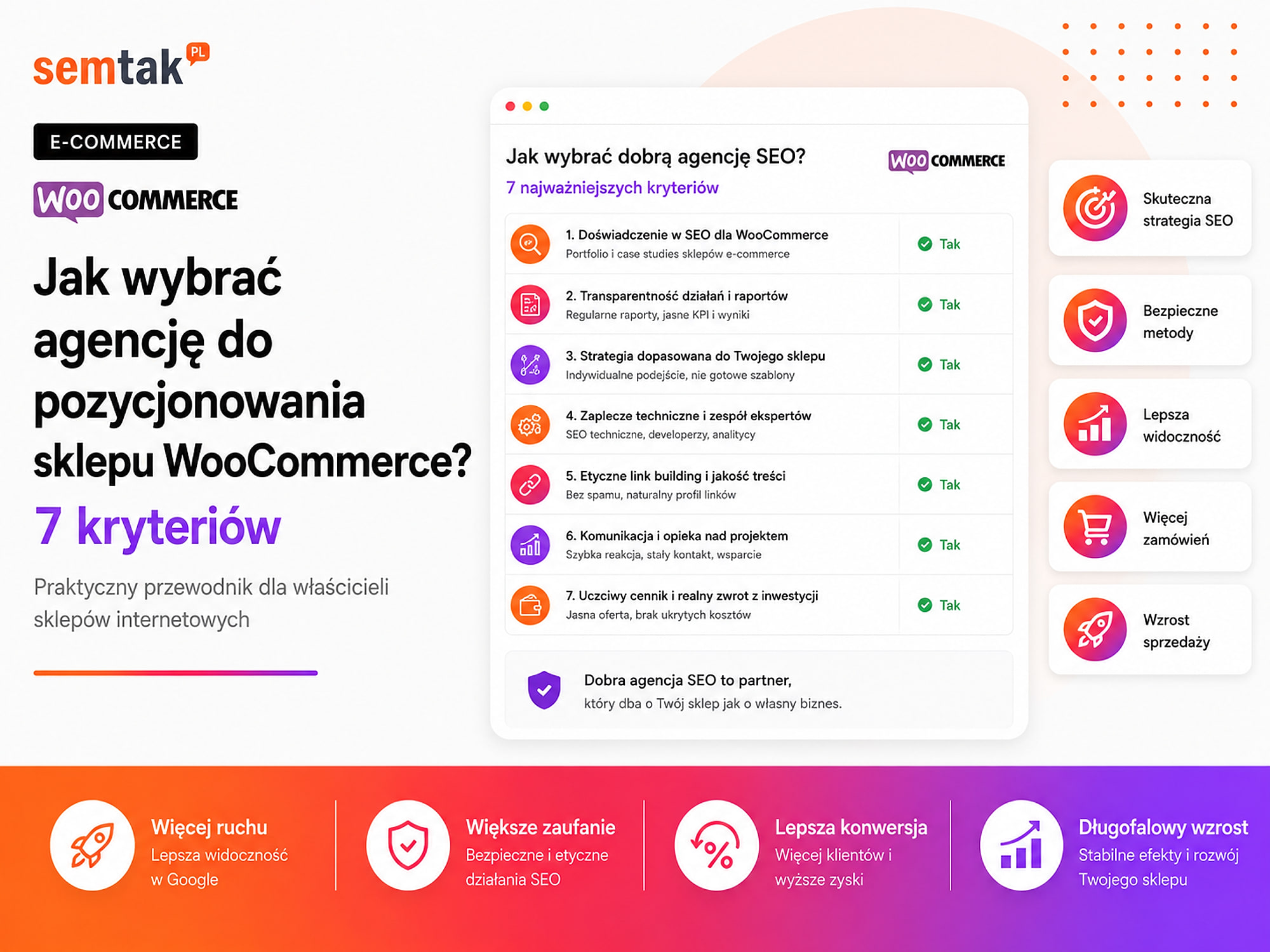
Choosing an SEO agency for a WooCommerce store should not begin with the question: "How much does positioning cost?". First you need to check whether the agency understands how an online store works, knows how to work with WooCommerce and will measure something more than the positions of a handful of keywords.
A store can have thousands of products, variants, filters, pagination and products that are temporarily unavailable. A single element set up incorrectly can create many unnecessary URLs or block important categories from Google.
From this guide you will learn how to compare offers, what questions to ask during the first conversation and how to recognise that an attractive presentation does not go hand in hand with a sensible plan of action. If you are already looking for a provider rather than just information, take a look at how SEMTAK handles online store SEO.
In short: you will recognise a good agency by the fact that it starts with a diagnosis of the store, measures sales rather than positions alone, is able to see changes through to implementation and shows the client the data. It does not promise first place in Google — it clearly explains what it will do, why, and how it will assess the result.
In a nutshell (TL;DR)
- Choose a company that knows WooCommerce, not just the general principles of SEO.
- Ask for a diagnosis of the store before signing a long contract.
- Set business goals: sales, revenue and the growth of important categories.
- Check whether the offer includes implementation or only the preparation of recommendations.
- The report should show the work carried out, the results and the plan for the following month.
- Avoid position guarantees, secret methods and unclear extra costs.
Why choosing an agency for a WooCommerce store requires extra care
Positioning a service website and an online store share the same foundations, but they differ in scale.
A WooCommerce store can contain thousands of product pages, categories and subcategories, product variants, filters and attributes, manufacturer pages, pagination, seasonal and discontinued products, as well as integrations with a warehouse, ERP or BaseLinker.
Example: filters create thousands of URLs
A store has 3,000 products and 12 filters. If each filter creates its own URLs and the user can combine several parameters at once, WooCommerce can generate thousands of page combinations. Instead of analysing the important categories, Google starts visiting URLs such as "colour black + size M + sort by cheapest". Some of these combinations may make sense for sales — most usually should not end up in the index. The agency has to be able to tell one from the other.
1. Check their experience working with WooCommerce stores
The first criterion should be practical knowledge of WooCommerce.
It is not enough for the name of the system to appear on the agency's website. During the conversation, the specialist should be able to point out problems typical of stores built on WordPress.
What to ask? Ask how the agency approaches:
- indexing of filters and attributes,
- categories and subcategories,
- pagination,
- unavailable products,
- redirects after a product is removed,
- product variants,
- WooCommerce performance,
- linking between guides, categories and products.
It is also worth asking about the Product, Offer and BreadcrumbList structured data — that is, the information passed to Google about the product, price, availability and category path. A good answer should not be limited to the sentence: "We'll install an SEO plugin and fill in the meta tags". A plugin can make it easier to manage titles, the sitemap or redirects, but it will not decide which filters are worth indexing, how to build the category structure or what to do with a discontinued product that has traffic and links.
A simple test during the conversation. Ask the question:
What would you do if Google indexed thousands of URLs created by filters and sorting?
The specialist should ask follow-up questions about the URL structure, linking and the sitemap. They may also mention the canonical (indicating the main version of similar URLs), noindex (marking a page to be skipped by Google), limiting links to random combinations and keeping selected filters as sales pages. If the only answer is "we'll block everything in robots.txt", be cautious — such a change without analysis can hide the problem rather than solve it.
2. The agency should start with a diagnosis, not a ready-made package
You cannot prepare a sensible strategy without checking the store, the competition and the results so far.
At the start you do not always need a full audit running to several dozen pages. You do, however, need a diagnosis that answers the basic questions: how big is the store, which categories and products generate traffic, is Google indexing the right URLs, does the store have technical problems, who is the real competitor in the search results and which activities have the best chance of affecting sales.
What data is worth checking? Most often it will be Google Search Console, Google Analytics 4, WooCommerce sales data, the XML sitemap, the robots.txt file, 404 errors and redirects, the category structure, the store's speed and the visibility of the most important subpages. In a larger store a crawl may also be needed — that is, an automated pass over the site's URLs to gather information about errors, headers, links and server response statuses.
Red flag
Be careful when an agency presents a detailed plan after a five-minute conversation but does not ask about the number of products, seasonality, the most important categories, the margin, previous migrations, implementation capabilities and access to data. A package can have a fixed price, but the strategy for a store with 300 products should not look identical to one for a store with 30,000 products.
Not sure where to start? See what an SEO audit of a store should cover and which problems are worth checking before starting a long-term partnership.
3. Set the business goals and the way effects are measured
Keyword positions are useful, but they should not be the only way to assess an agency's work.
A store can enter the TOP 10 for dozens of queries that do not lead to sales. The report then looks good, but the number of orders does not change. Before starting the partnership, decide what the result of the work should be: more sales from Google's free results, the growth of high-margin categories, increased traffic to products available all year round, recovered visibility after a migration, fewer unnecessary URLs in the index or less dependence on paid campaigns.
What is worth measuring?
| Store goal | Example metrics |
|---|---|
| Increasing sales | revenue, transactions, conversion rate |
| Growth of important categories | clicks, impressions, category sales |
| Product visibility | number of products generating traffic |
| Fixing technical problems | indexing errors, duplicates, 404 URLs |
| Growth of non-brand traffic | clicks from non-branded queries |
| Improving store performance | speed, Core Web Vitals, mobile stability |
Not every increase in traffic is a good result. An article on the history of garden furniture may attract a lot of visits but few orders. A guide titled "How to choose a furniture set for a small terrace?" may get less traffic but lead the user straight to the right category. Before you start, it is worth recording a point of reference: current traffic, revenue from SEO, the number of transactions and the results of the most important categories. Without it, it is hard to honestly assess the change later on.
4. Check the specific scope of work and the responsibility for implementation
The word "positioning" can mean very different services.
One agency will prepare the analysis, the content and the links and will implement the changes in WooCommerce. Another will send a list of recommendations to be carried out by your developer. A third will focus mainly on blog articles. Any model can work, but the scope must be clear before signing the contract.
What can the cooperation cover? Technical and indexing analysis, keyword analysis, the growth of categories and subcategories, improvements to product pages, filter analysis, content preparation, internal linking, structured data, link building, results monitoring and the implementation of changes.
The most important question: who will implement the recommendations? An audit may indicate that you need to improve sitemap generation, change how filters work, implement redirects, tidy up the product data, improve the category template or speed up the database. If the agency does not carry out such changes, it should prepare tasks that are understandable to a developer and later check the implementation. The recommendation "improve store speed" is not a technical task — the task should indicate what is slowing the site down, where the problem occurs and how to tell that it has been fixed. For more technical problems, separate technical SEO may be needed, or cooperation between the agency and a WooCommerce maintainer.
5. Assess the reporting and the access to data
A good report should not be an automated file with a table of several hundred keywords.
After reading it you should know:
- What was done?
- Why were those particular activities chosen?
- What changed in the results?
- What problems were detected?
- What will be done next?
What can a monthly summary contain? The technical changes made, the content prepared and improved, the categories developed, the links published, the changes in clicks and impressions, the revenue and transactions from SEO, the problems detected and the plan for the following month. The report should explain the data, not just present it. A drop in traffic may result from a technical problem, but also from seasonality, a lack of stock or reduced demand — it is the agency's job to spot the difference.
The accounts should belong to the store owner
Google Analytics, Search Console, Merchant Center and other important tools should be set up under the client's details or provide the client with full administrative rights. When the cooperation ends, you should not lose the history of the data, access to the accounts, the content prepared, the documentation, the list of links acquired or the information about changes in the store. The agency is given access to the data — it should not become its owner.
6. Check the approach to content and link building
Content and links can support a store's visibility, but their quantity will not replace a strategy.
Publishing four random articles a month will not help if the categories are built poorly or Google is indexing thousands of unnecessary pages.
How to assess a content plan? The agency should explain which category a given article supports, what customer question it answers, where the internal links lead, who checks the accuracy of the information and whether the content will be updated. A good store blog should not be a separate magazine with no connection to the offer. An example path: a guide on choosing a mattress → the mattress category → the chosen type → the product page. If the store structure is not yet tidy, our guide on the architecture of WooCommerce categories will come in handy: WooCommerce store categories — SEO architecture (in Polish).
How to assess link building? Ask where the links will come from, whether you will see the places of publication, whether the publications are related to the store's subject, whether the links will remain after the contract ends, whether the report includes the address of each publication and whether you can reject a weak site. Answers that should raise concern: "it's a secret", "we don't show the places of publication" or "we'll add thousands of links in the first month". In link building, the context and the quality of the place matter, not the number of links alone.
7. Read the contract and add up all the costs
Even a good strategy can become a source of problems if the scope of the subscription is unclear.
What to check before signing the contract? Pay attention to the minimum cooperation period, the notice period, the exact scope of work, the cost of content, the budget for publications, the developer's cost, the cost of additional tools, the rules for approving changes, the frequency of reports, the method of contact and the handover of data once the cooperation ends.
A price "from £399 a month" tells you little until you know whether it covers content, publications, technical implementation and consultations. An offer of £499 that includes a report and one article may be less advantageous than an offer of £899 covering analysis, work on categories, implementation and content. You will find more about billing models in our guide on how much store positioning costs: how much does positioning an online store cost (in Polish).
An agency scoring table — a simple points system
You can rate each company on a scale from 0 to 2 points.
- 0 points — no answer or an unclear promise,
- 1 point — a general or partial answer,
- 2 points — a specific answer backed by a process and an example.
| Criterion | Score 0–2 |
|---|---|
| Knowledge of WooCommerce | |
| Diagnosis before strategy | |
| Business goals and measurement | |
| Specific scope of work | |
| Responsibility for implementation | |
| Transparency of reports | |
| Approach to content | |
| Approach to link building | |
| Client access to data | |
| Clear contract terms | |
| Transparency of costs | |
| Communication with the account manager |
The maximum score is 24 points. This does not mean that a company scoring 22 will always be better than one scoring 20. The table does, however, help to structure the conversations and avoid making a decision based solely on price or a sales presentation.
12 questions worth asking during the first conversation
- Which WooCommerce stores have you handled before?
- How do you check the indexing of filters and parameters?
- How do you choose the categories and products to work on?
- What data do you need before preparing the strategy?
- How will you measure sales from organic traffic?
- Who implements the technical fixes?
- What exactly will be done each month?
- What does a report look like and can we see an example?
- How do you choose article topics?
- Where will the links come from?
- Who will own the accounts, the content and the data?
- How can the cooperation be ended and what will we receive then?
You do not need to know the correct answer to every question. Pay attention to whether the specialist explains the topic clearly, asks about the store and is able to justify their decisions.
The most common warning signs
| Red flag | What there should be instead |
|---|---|
| "We guarantee first place in Google" | A realistic plan, a defined scope of responsibility and a way of measuring effects |
| A strategy without checking the store | An initial diagnosis of the data, technical state and competition |
| A report with keyword positions only | Data on clicks, sales, categories and the work carried out |
| No information about the activities | A list of changes together with a justification and a plan for further work |
| "Our methods are secret" | A clear explanation of the type of activities and their possible consequences |
| Hundreds or thousands of links in a short time | Gradual link building with control over the places of publication |
| A long contract with no clear notice period | Clear terms for ending the cooperation |
| Content published without approval | A process of editorial review and alignment with the store's offer |
| No questions about sales and availability | An analysis of margin, seasonality and stock levels |
| Accounts set up by the agency only | Owner-level client access to all important tools |
Never trust a position guarantee
No agency controls Google's algorithm or the competition's activities. "We guarantee first place" or "TOP 3 in a month" is a warning sign, not an asset. An agency can guarantee the delivery of the scope, the reporting and correct implementation — not a specific position.
SEO does not work in isolation from sales
The agency should understand that more traffic does not always mean a better result.
Example: a category's visibility grows, but most of the products are unavailable. Users arrive at the store, do not find the goods and leave. Traffic rises while the conversion rate falls. In such a situation the problem is not solely about SEO — you have to combine visibility data with product availability, prices, delivery and how the store works. For problems that go beyond visibility alone, technical maintenance of a WooCommerce store may be needed.
What can you check yourself?
Before talking to an agency, carry out five simple steps.
1. Check Search Console. See which pages generate clicks and whether there are indexing problems.
2. Check sales from SEO. Compare revenue, transactions and the conversion rate over the last few months.
3. Type your most important categories into Google. Check whether the right subpages appear or random products do.
4. Use the query site:yourdomain.com. Look for empty tags, filters, the internal search and test pages.
5. Compare the scopes of the offers. Write down the analysis, content, links, implementation and extra costs separately.
This will not replace a full technical analysis, but it will let you better assess the answers during the meeting. You can carry out a full diagnosis of the store as part of an SEO audit of a store.
When is it worth handing this over to a specialist?
A specialist's help is especially needed when:
- the store has several thousand products,
- filters create a large number of URLs,
- visibility dropped after a migration,
- important categories do not appear in Google,
- Search Console shows many excluded pages,
- products are indexed incorrectly,
- the store runs slowly,
- you cannot connect traffic with revenue,
- you are planning to change the domain or category structure,
- the current agency cannot explain its reports.
In a small store, some errors can be fixed manually. With several thousand products, one rule set up incorrectly can affect hundreds or thousands of URLs. In such a situation it is better to start with a diagnosis and a list of priorities than with the random publication of more articles.
Frequently asked questions
Does the agency have to specialise exclusively in WooCommerce?
No. It should, however, know the technical problems of this platform. Ask for examples relating to filters, variants, categories, speed and product data.
Is it worth choosing an agency based on a case study alone?
No. A case study is helpful when it shows the starting point, the scope of the work carried out and the way the effects were measured. A growth chart on its own, without context, tells you very little.
Can an agency guarantee first positions?
No. It can guarantee the delivery of the agreed scope, the reporting and correct implementation. It does not, however, control Google's algorithm or the competition's activities.
Is an SEO audit needed before starting cooperation?
Most often yes, although its scope depends on the size of the store. Without a diagnosis it is hard to establish whether the bigger problem lies in content, structure, indexing, links or the technical state.
How long should the contract last?
SEO requires regular work, but the contract should have a clear notice period. The long time needed for results does not justify unclear terms.
Does the cheapest offer always mean a smaller scope?
Not always. You have to check whether the price covers analysis, content, publications, technical implementation, developer work and reporting.
Should the agency have access to WooCommerce?
For a full analysis and implementation, usually yes. Access should be granted by name, with the appropriate permissions and the ability to revoke it quickly.
Can you change agencies without losing your results?
Yes. You do, however, have to take over the accounts, the data, the content, the list of changes, the reports and the information about links. The new provider should first analyse the work done so far.
Order an initial visibility analysis of your store
Do not choose a company based solely on price, the number of keywords in the package or the promise of fast growth. A good agency does not have to promise an immediate TOP 3 — it should be able to show what is blocking the store, which activities make the most sense and how their result will be assessed. If you are not sure whether the problem is the category structure, indexing, content, links or the way WooCommerce works, start with an initial analysis:
- Online store SEO — an ongoing partnership focused on sales, not positions alone.
- SEO audit of a store — a list of the most important problems and priorities to start with.
- Technical SEO — when the problem lies in indexing, filters or speed.
- How much does store positioning cost (in Polish) — billing models and what is included in the price.