WooCommerce vs Magento — which platform should you choose for your store?

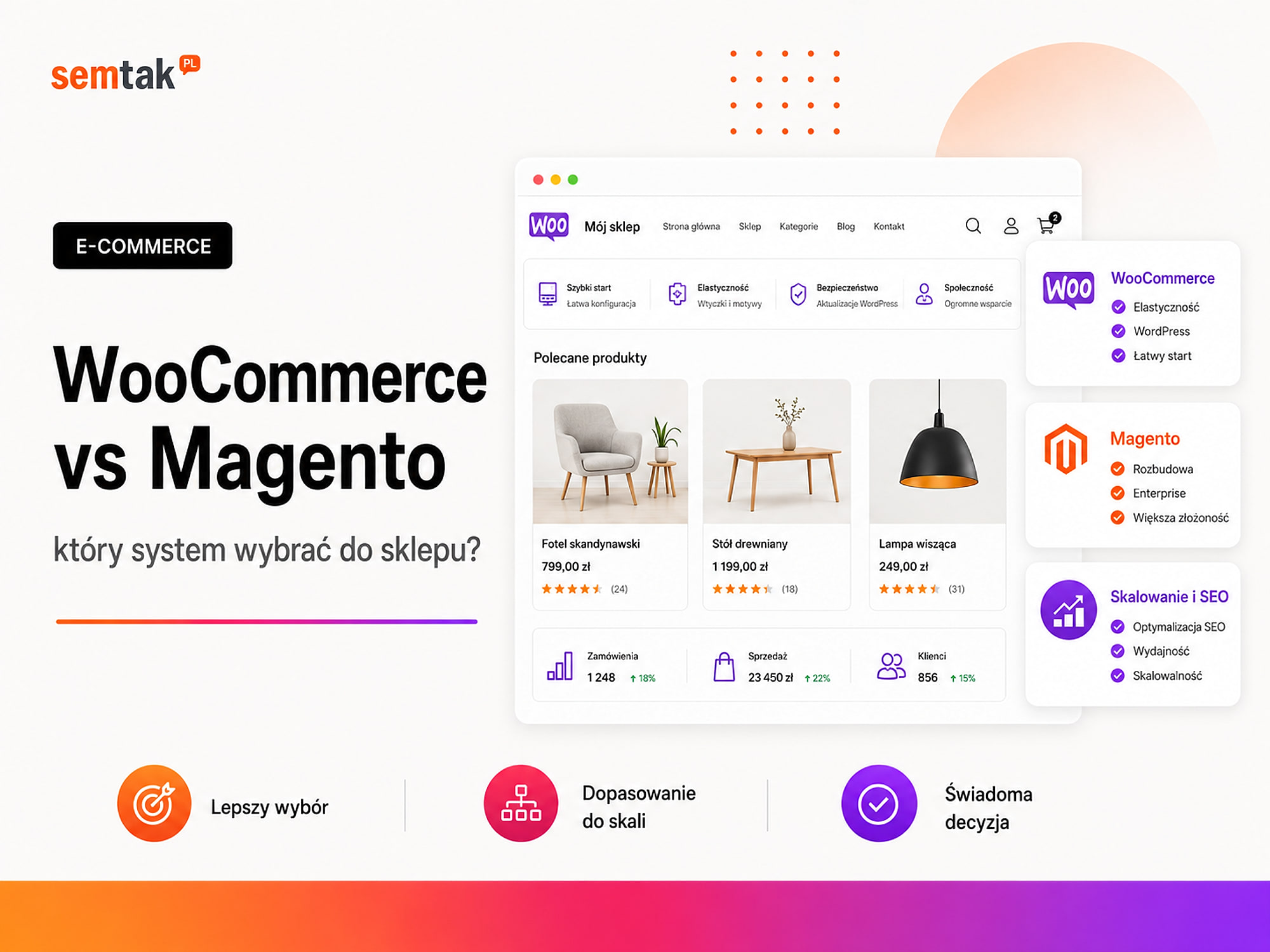
WooCommerce and Magento both let you build a comprehensive online store, connect it to a warehouse, launch international sales and develop your own features. That is roughly where the similarities end.
WooCommerce is an extension of WordPress. It has a lower entry barrier, a simpler technical foundation and pairs sales very well with a blog, landing pages and SEO. Magento is a standalone e-commerce platform designed with more complex catalogues, multiple stores, markets and enterprise processes in mind.
The problem is that companies often choose a platform based on the number of products or a contractor's opinion. Meanwhile, a store with 100,000 simple products can have a simpler architecture than a wholesaler with 5,000 products, individual price lists, six warehouses and separate terms for each business partner.
In this comparison we explain how WooCommerce, Magento Open Source and Adobe Commerce differ, how much they cost to maintain, and when Magento's greater complexity is genuinely justified from a business standpoint.
In short
For most small and medium-sized stores, WooCommerce will be the more sensible choice — it is cheaper to implement, simpler to maintain and more convenient when the store develops SEO, a blog and campaigns. Magento Open Source or Adobe Commerce is worth considering when a company runs multiple stores and markets, has a complex catalogue, extensive B2B processes and its own technical team. A large number of products alone is not a sufficient reason to choose Magento.
In short (TL;DR)
- Choose WooCommerce when you care about a lower entry cost, simpler operation, strong SEO and freedom to develop content.
- Magento Open Source is free to licence, but its implementation, server and later operation are usually more demanding.
- Adobe Commerce is the commercial edition for larger organisations, with extensive B2B features, multi-store capability and vendor support.
- Magento has the advantage when you have multiple brands, markets, warehouses and complex commercial rules.
- WooCommerce can handle a large store if it has a well-planned database, integrations, cache and infrastructure.
- The number of products should not be the main criterion. Variants, traffic, the number of orders, price lists, warehouses and integrations matter more.
- Both platforms can run fast and rank well. The result is determined by the quality of the implementation.
- Before choosing a platform, test the store's hardest process, not just the homepage and the look of a product page.
An important distinction first: Magento Open Source or Adobe Commerce?
The name "Magento" is used to describe two different solutions — the free Magento Open Source and the commercial Adobe Commerce.
Magento Open Source is a free, open-source platform. You do not pay for the licence itself, but you are responsible for the server, implementation, updates, security, monitoring, backups, feature development and technical support on your own. It provides a basic sales engine, product catalogue, orders, promotions, multiple stores and multi-source inventory management — but it does not include the full set of features characteristic of the commercial Adobe Commerce.
Adobe Commerce is a commercial platform built on top of Magento, aimed primarily at medium-sized and large organisations running complex B2C or B2B sales. It can include company accounts, multiple users within one company, individual catalogues and prices, quote requests, shopping lists, order approval processes, deferred payment, advanced merchandising features, cloud solutions and vendor support. Adobe does not publish a single, simple price list — the offer is prepared individually.
Magento Open Source ≠ Adobe Commerce — check the edition
A feature described on the Adobe Commerce website is not necessarily in the free Magento Open Source. This is the most common misunderstanding when choosing — in this article we use the word "Magento" as a shorthand, but for features available only in the paid version we note that it specifically means Adobe Commerce. Before making a decision, always confirm which edition contains the feature you need.
WooCommerce vs Magento — the key differences
| Criterion | WooCommerce | Magento Open Source / Adobe Commerce |
|---|---|---|
| System type | WordPress extension | Standalone e-commerce platform |
| Base licence | Free, open source | Magento Open Source free; Adobe Commerce paid |
| Entry barrier | Lower | Higher |
| Implementation time | Usually shorter | Usually longer |
| Maintenance cost | Low to medium | Medium to high |
| Hosting | Good managed hosting or VPS | Usually a powerful VPS, dedicated server or cloud |
| Content handling | Very strong thanks to WordPress | Decent, but more store-oriented than content-oriented |
| SEO and blog | Very good foundation | Good, requires deliberate implementation |
| Multi-store | Possible, often requires separate architecture | Extensive hierarchy of multiple websites and stores |
| Multiple warehouses | Via integrations or extensions | Extensive multi-source inventory management |
| B2B | Extensions and custom code | Strongest native features in Adobe Commerce |
| API and headless | REST API, Store API, webhooks | REST, GraphQL and an extensive API-first approach |
| Availability of specialists | High | Smaller and more specialised |
| Who is it for? | Small, medium and some large stores | Complex e-commerce and enterprise organisations |
WooCommerce and Magento have a different architecture
WooCommerce combines store and content in one system, whereas Magento is a commerce platform from the ground up.
WooCommerce works as part of WordPress: WordPress handles pages, posts, users and content, while WooCommerce adds products, variants, cart, checkout, orders, payments, shipping, taxes, coupons and stock levels. Thanks to this, you can easily combine a product category, a buying guide, a campaign landing page, a knowledge base, a manufacturer page, a configuration form and SEO content.
Magento is a commerce platform from the start — the catalogue, prices, stores, warehouses and sales processes are the centre of the system. Content matters, but commerce and organisational structure are the starting point. In practice: WooCommerce is easier to adapt to a company where the store, content and marketing grow together; Magento is a better fit for an organisation where the sales platform is part of a larger ERP, PIM, WMS, CRM and multi-channel architecture. ERP is a system that manages a company's resources (sales, accounting, warehouse), PIM manages product information (names, images, parameters, translations), and WMS manages warehouse operations.
Which platform is easier to launch?
WooCommerce lets you start in stages; a Magento implementation is usually a development project.
WooCommerce. A simple store can be launched relatively quickly: install WordPress → install WooCommerce → configure the theme → add payments → set up shipping → import products → test an order → enable analytics and SEO. That does not mean a professional store is built in a few hours — you still need to plan categories, variants, integrations and the purchase process. WooCommerce does, however, allow you to roll out a store in stages: start with a basic scope and later add a loyalty programme, B2B sales, further language versions, an ERP integration, automations and a product configurator.
Magento. The implementation is usually a development project, not the configuration of a ready-made panel. You need to plan the server architecture, the code deployment process, catalogue indexing, the search mechanism, cache, task queues, integrations, a test environment, monitoring and an update procedure. Magento makes sense when a company is ready to maintain such an architecture — if every minor change is to be made by a random freelancer available once every few weeks, the risk grows.
WooCommerce vs Magento — implementation and maintenance costs
A free licence does not mean a free store — the biggest difference concerns the scale of the technical backend.
In both systems you have to pay for analysis, UX design, implementation, hosting, integrations, extensions, data migration, testing, updates, monitoring and development.
| Cost | WooCommerce | Magento Open Source | Adobe Commerce |
|---|---|---|---|
| System licence | No fee | No fee | Individual quote |
| Simple implementation | Possible | Usually not cost-effective | Not the main use case |
| Custom frontend | Medium to high cost | High cost | High cost |
| Infrastructure | From managed hosting to VPS | Usually stronger and more complex | Cloud or enterprise infrastructure |
| Updates | Usually simpler | More technical | Technical, partly supported by the vendor |
| Feature development | Plugins and custom code | Modules and custom code | Modules, custom code and Adobe services |
| Maintenance team | Can be small | Magento and DevOps skills needed | Usually a team or implementation partner |
How much WooCommerce can cost. A standard professional store can cost anywhere from several to several tens of thousands of pounds — depending on the design, products and integrations. Detailed variants are in the article how much an online store costs on WooCommerce.
How much Magento can cost. With Magento Open Source the platform code is free, but not the whole implementation — the budget has to cover a specialist implementation, server, catalogue search engine, cache, the update process, developer support, regression testing and integration maintenance. In practice, Magento Open Source is rarely an economical choice for a small store — even if the initial implementation is heavily limited, later updates and development require specialist support. Adobe Commerce additionally requires purchasing a commercial solution based on an individual offer.
TCO matters more than the starting price
TCO (total cost of ownership) covers all expenses over a multi-year period:
implementation
+ licences
+ server
+ updates
+ development
+ monitoring
+ repairs
+ team
+ migrations
A platform can be free on the day of installation and expensive after three years of maintenance. Before choosing, calculate the cost for at least three years, not just the price of the first launch.
Hosting and infrastructure — Magento is more demanding
WooCommerce can run on good managed hosting; Magento has more dependencies and a more complex deployment process.
A growing WooCommerce store often later moves to a VPS or its own server. For a larger store, the right PHP and database version, page and object cache, Redis, CDN, system Cron, monitoring, a separate staging and correct database configuration are important. System Cron is a server mechanism that runs scheduled tasks in the background at set times — in WordPress it can replace the default WP-Cron (which runs tasks during user visits), ensuring more predictable execution of imports, queues and synchronisation. More in the guide hosting for WooCommerce — how to choose a server.
A production Magento installation may use, among others, OpenSearch for search, Redis for cache and sessions, Varnish as a caching layer, a message queue, Composer for package management, indexing mechanisms and separate test and production environments. Not every Magento store uses an identical configuration, but ordinary cheap shared hosting is not the right starting point.
Is Magento automatically faster? No. Both platforms can run fast or slow. WooCommerce slows down due to, among other things, poor hosting, too many plugins, a heavy theme, badly written filters, uncontrolled variants, large images and a lack of cache. Magento slows down due to, among other things, bad index configuration, a mismatched server, heavy extensions, code errors, the wrong cache, badly designed integrations and excessive data loaded on every request. A platform's logo does not solve performance problems.
Does Magento handle large stores better?
Magento was designed for extensive commercial structures, but a well-prepared WooCommerce will also handle a large store — the difficulty is determined not by the number of products, but by the complexity of the processes.
Magento has strong mechanisms for multiple websites and stores, separate language views, product attributes, extensive pricing rules, catalogue indexing, multi-source inventory management and integration via API. This does not mean, however, that WooCommerce is only suitable for a small store — a well-prepared one can handle a large catalogue, many variants, high traffic, B2B sales, ERP integration, several languages, automated imports and sales across several channels.
The most important question is not "how many products will the store have?", but: how many variants does a single product have; how often do prices change; how many orders come in simultaneously; how many warehouses serve sales; how many price lists apply to customers; how many product pages an import updates; how many stores and domains should run from one system; how much data the integrations transfer; whether the store must run uninterrupted during updates.
Example. Store A has 100,000 books — each product has one price, one stock level, one image, one supplier and simple shipping. Store B has 5,000 industrial products — each can have dozens of variants, prices depending on the company, separate MOQs, several warehouses, multiple sales units, individual delivery times, a configurator and order approval. Store B can be technically harder despite the smaller number of products. MOQ is the minimum number of units or value from which an order can be placed.
Products, variants and catalogue
WooCommerce has a simpler catalogue model, Magento a more extensive attribute model; in both you have to design the catalogue.
WooCommerce provides simple, variable, grouped, external, virtual and digital products, attributes, categories and tags, and basic stock management; additional types and configurators are implemented through extensions or custom code. With a very large number of variants you have to watch out for database size, panel speed, generating combinations, filters, imports and stock synchronisation.
Magento has a more extensive catalogue and attribute model — it supports simple, configurable, grouped, bundle, virtual and downloadable products, extensive attribute sets, pricing rules and multiple configuration scopes. With complex product data, such a structure can reduce the number of additional extensions — but the catalogue "won't build itself". You still have to design the product model, attributes, variants, relationships, categories, data source and synchronisation with a PIM or ERP.
Multiple warehouses and inventory sources
Magento has native multi-source inventory management; in WooCommerce, multiple warehouses are usually implemented via ERP, WMS or an integration.
In Magento Open Source and Adobe Commerce a source can be a warehouse, a brick-and-mortar store, a distribution centre, a pickup point or a dropshipper, and the system can combine sources into stock assigned to specific sales channels. WooCommerce offers simpler warehouse management by default — multiple warehouses are most often implemented via ERP, WMS, an additional plugin or a custom integration. If stock is managed in an external ERP anyway, the platform's native warehouse may matter less — the correct connection of systems becomes key.
Multiple stores, brands and countries
Magento has a native hierarchy of websites, stores and views; WooCommerce builds multilingualism through plugins or separate installations.
Magento has a native hierarchy:
Installation
├── Website A
│   ├── Store 1
│   │   ├── English view
│   │   └── German view
│   └── Store 2
└── Website B
    └── Store 3
This lets you manage several domains, brands, catalogues, languages, currencies, prices and regional settings from a single installation. This flexibility has a price — you have to carefully watch the scope of each configuration so that a change for one store does not affect the others.
WooCommerce lets you build multiple language versions and markets through WPML, Polylang, separate installations, WordPress Multisite, an integration linking several stores or a separate headless frontend. For two or three similar language versions WooCommerce can be simpler; with a dozen brands, domains, catalogues and pricing policies, Magento's native structure tends to be more convenient than a set of multiple WordPress installations.
WooCommerce vs Magento for a B2B store
This is an area where you need to distinguish Magento Open Source from Adobe Commerce — the strongest B2B features are in the commercial edition.
WooCommerce B2B can handle net prices, group discounts, individual price lists, minimum order values, sales in bulk packs, hiding prices, deferred payments, company accounts, quick ordering and ERP integration — most of it through extensions or custom code. More in the guide B2B store on WooCommerce.
Magento Open Source B2B provides a solid catalogue, customer accounts and pricing rules, but does not include the entire enterprise B2B package available in Adobe Commerce — some features have to be implemented through modules or custom code.
Adobe Commerce B2B can natively provide company accounts, employee hierarchies, buyer roles and permissions, shared catalogues, company-assigned prices, quote requests, shopping lists, quick ordering by SKU, purchase approval and payment on trade credit. If a company needs most of these features at once and serves many large business partners, Adobe Commerce can reduce the number of individual modules.
| Feature | WooCommerce | Magento Open Source | Adobe Commerce |
|---|---|---|---|
| Group prices | Extension or code | Rules and modules | Extensive features |
| Price list for a specific company | Plugin or integration | Module or code | Shared catalogues |
| Multiple users per company | Plugin or code | Module | Native feature |
| Order approval process | Dedicated implementation | Dedicated implementation | B2B feature |
| Quote requests | Plugin or code | Module | B2B feature |
| Quick ordering by SKU | Plugin | Possible extension | B2B feature |
| ERP integration | API or integrator | API or integrator | API or integrator |
Adobe Commerce is not automatically the best choice for every wholesaler — if you only need net prices and a few discount groups, implementing a whole enterprise platform may be disproportionate to the problem.
Integrations, API and automations
Both systems integrate with ERP, PIM, WMS, CRM, accounting, marketplaces, wholesalers, couriers and payment operators — the advantage is determined by the design of the data flow, not the number of endpoints.
WooCommerce exposes a REST API, Store API, webhooks, WordPress mechanisms and a large number of ready-made plugins. It is a good environment for integrations, especially when you connect the store to a popular system. A problem may arise when several plugins simultaneously update prices, change stock, create documents, process orders and send data to external services — then you have to clearly establish a single source of truth for each piece of information.
Magento offers extensive REST and GraphQL interfaces and an architecture prepared to work with a larger ecosystem of systems. This does not mean the integration will be simple — the more processes there are, the more important queues, retries, logs, idempotency, monitoring, error handling and incremental synchronisation become. Retry is repeating an operation after a temporary error; idempotency is designing the integration so that repeating the same request does not create a duplicate order, payment or product.
Which platform is better for headless commerce?
Both systems can run headless (separating the layer visible to the customer from the store engine), but headless should not be the default choice.
WooCommerce headless can be connected to your own frontend via API — this makes sense when a company needs an unusual interface, a mobile app, several channels using one catalogue or a very individual purchase process. Magento and Adobe Commerce have extensive APIs and GraphQL, which is why they fit larger composable and headless architectures well. In both cases, however, you add a separate frontend, separate deployments, additional monitoring, cache handling, SEO rendering, data synchronisation and a larger team. More in the article what headless commerce is.
SEO — WooCommerce or Magento?
No system guarantees rankings; WooCommerce's advantage is WordPress as a content backend.
Both let you implement readable URLs, meta title and description, structured data, XML sitemaps, canonicals, breadcrumbs, category descriptions, product content and internal linking. WooCommerce's advantage is WordPress — in one panel you run the store, blog, guides, rankings, brand pages, landing pages, seasonal content and a knowledge base. This matters when the sales strategy relies on SEO and content marketing; adding a guide, expanding a category or creating a campaign page usually does not require a separate CMS.
Magento can also be ranked effectively, but you have to carefully plan product URLs across multiple stores, language views, filter parameters, canonicals, pagination, variant duplicates, search engine indexing and frontend performance — with an extensive multi-website structure, a single configuration error can affect thousands of URLs. In both systems SEO should be part of the implementation, not a fix added after publication.
Store operation and day-to-day work
The WooCommerce panel is part of WordPress and simpler for many people; the Magento panel is more extensive.
The WooCommerce panel keeps products, orders, content, pages, posts, users and settings in one place. A large number of plugins can, however, introduce clutter — each extension adds its own menus, messages and settings. The Magento panel has more settings related to website scope, store, language view, catalogue, indexes, promotions, warehouses and integrations. For someone managing a simple store it can be overwhelming; for a team serving many brands and markets, that same level of detail can be an advantage. Before choosing a platform, show the panel to the people who will be adding products, changing prices, handling orders, creating promotions and publishing content every day.
Updates, security and maintenance
Both systems require regular care; Magento updates are a more complex technical process.
WooCommerce. You have to update WordPress, WooCommerce, the theme, plugins, PHP and integrations. The biggest risk is a conflict between extensions or an abandoned plugin. It is worth testing updates on staging, especially when they affect checkout, payments, prices, shipping, variants or the API.
Magento. Updates may require updating packages, checking dependencies, running deployment commands, updating the database, re-indexing, compilation, module tests and integration tests. The store should have a documented process for deploying changes — if a company has neither a technical team nor a permanent partner, maintaining Magento can become a bottleneck. More about updates, backups and protection in the guide WooCommerce store security.
Availability of specialists and the risk of contractor lock-in
WooCommerce benefits from the broad WordPress ecosystem; Magento is more specialised.
With WooCommerce it is usually easier to find an administrator, a PHP developer, a WordPress specialist, an SEO agency, a content person and a technical maintainer. This does not mean that every WordPress specialist can build a good store — integrations, performance and B2B require WooCommerce experience. Magento requires a contractor familiar with Magento architecture, Composer, modules, indexing, cache, GraphQL or REST, the update process and infrastructure. Before choosing Magento, check not only the implementation company but also the plan for what to do if you change contractor — ask for the code repository, documentation, accesses owned by the company, a description of integrations, the deployment procedure, a list of modules, a maintenance contract and the rules for handing over the project.
Example choice scenarios
Scenario 1: a cosmetics store, 3,000 products. The company sells domestically, develops guides, category descriptions, product ads and seasonal landing pages; it needs good SEO, a blog, an integration with its system, local payments, parcel lockers and simple promotions. Sensible choice: WooCommerce. Magento would increase technical costs without a clear business advantage.
Scenario 2: a B2B manufacturer, 20,000 SKUs, five countries. Each company has its own price list, an individual catalogue, several employees, purchase limits, an approval process plus offers and negotiations; the company runs several brands and warehouses. For analysis: Adobe Commerce. WooCommerce can still handle such a project, but you have to compare the cost of custom features with Adobe Commerce's B2B features.
Scenario 3: a wholesaler, 15,000 simple products. Sales in one country, prices in four groups, all products/stock/invoices from the ERP. A sensible choice may be WooCommerce. The quality of the ERP integration is decisive, not the number of products.
Scenario 4: a trading group with multiple brands. The company manages a dozen domains, different catalogues, multiple languages, separate price lists, several teams and its own IT backend. Magento or Adobe Commerce may have the advantage — the native hierarchy of websites, stores and views simplifies management from one system.
Scenario 5: a startup launching its first store. The company does not yet have a confirmed sales model and wants to test the offer, ads and the logistics process. Sensible choice: WooCommerce. At this stage, quickly validating the market is more valuable than building an enterprise architecture.
When to choose WooCommerce?
WooCommerce will be the better choice when its simpler architecture is enough to handle the company's real processes.
This applies when you are launching your first or another medium-sized store, you want to start in stages, SEO/blog/content marketing matters, you operate mainly domestically or in a few similar markets, you use popular payments/couriers/accounting, you need an integration with an ERP, you want to develop landing pages easily, you do not have a separate Magento and DevOps team, you care about cost control or you need unusual features but not a whole enterprise architecture. WooCommerce is not "a system only for small stores".
When to choose Magento Open Source?
Magento Open Source is worth considering when its greater complexity solves a specific problem — not because it is free.
This applies when you have an extensive catalogue and attribute model, you manage multiple stores from one installation, you need a native website/store/view structure, you use multiple inventory sources, you have a Magento team or a permanent partner, you accept higher infrastructure and maintenance costs, you integrate the platform with an extensive backend of systems or you want to build on a genuinely commerce-focused platform rather than a CMS. The free licence is a small part of the total cost.
When to choose Adobe Commerce?
Adobe Commerce makes sense at large scale, with multiple brands and extensive B2B — provided you use the features you pay for.
This applies when you run sales at large scale, you manage multiple brands and markets, you need extensive B2B, you require company accounts and employee hierarchies, you need individual catalogues and prices, you handle a quoting and approval process, you want to use Adobe's services and support, you have an enterprise budget or the platform is one of the organisation's main systems. Do not buy Adobe Commerce just because the company plans to grow — first check whether you will use the features you pay for.
When not to choose Magento?
Magento can be a bad choice when the budget is only enough to launch, but not to maintain.
This also applies when you do not have a permanent technical team, the store has standard products and one market, most sales depend on content and SEO, you need to launch an MVP quickly, you want to make every change yourself, the company does not have organised product data, there is no integration plan, the only argument is the number of products, or the choice stems from the belief that "a big company must have Magento". Extensive technology will not fix disorganised processes.
The most common mistakes when choosing WooCommerce or Magento
The most damage is done by: choosing by the number of products, confusing Magento editions and comparing the licence alone.
Choosing based on the number of products. The number of SKUs is just one parameter — you have to take into account variants, traffic, prices, orders, warehouses and integrations.
Confusing Magento Open Source with Adobe Commerce. A feature described on the Adobe Commerce website is not necessarily in the free Magento Open Source — check the system edition carefully.
Comparing only the licence cost. Both base open-source platforms can be downloaded for free; the real cost is made up of implementation, infrastructure and maintenance.
No post-launch care plan. A store requires updates and monitoring regardless of the platform.
Assuming the platform will solve SEO. The system provides the tools; visibility depends on structure, content, indexing, speed and linking.
Over-building the first version. The company tries to implement all markets, warehouses, automations and B2B features at once — the project drags on, and the sales model has not been validated.
No test of the hardest process. A demo usually shows the homepage and a product. Before choosing, test the process that really decides the project: calculating a price for a specific company, an order from two warehouses, importing 50,000 products, changing 10,000 prices, synchronising a return to the ERP, B2B order approval or handling several language versions.
Migration between Magento and WooCommerce
Platform migration is not only about moving products — the biggest SEO threat is changing URLs without proper redirects.
You have to account for products, variants, categories, attributes, customers, orders, passwords, coupons, reviews, images, prices, stock, integrations, URLs, metadata, structured data, analytics and the product feed.
Old Magento URL:
/furniture/chairs/ergoflex-office-chair.html

New WooCommerce URL:
/product/ergoflex-office-chair/
A 301 to the matching product, not to the homepage
The old URL should lead via a 301 redirect directly to its matching product. Do not redirect all old products to the homepage — that is the most common mistake that destroys visibility after a migration. We described the full process in the guide store migration without losing rankings.
WooCommerce vs Magento — decision table
| Question | WooCommerce | Magento / Adobe Commerce |
|---|---|---|
| Do you want to launch your first store quickly? | Yes | Usually no |
| Should the store run in one market? | Yes | Possible, but often excessive |
| Are SEO and a blog an important sales channel? | Big advantage | Possible, but requires more work |
| Do you need several language versions? | Yes | Yes |
| Do you manage a dozen brands and domains? | Requires a multi-installation architecture | Native advantage |
| Do you have multiple warehouses? | Via ERP or extensions | Extensive native features |
| Do you need simple B2B? | Good choice | Magento Open Source also possible |
| Do you need advanced enterprise B2B? | Lots of custom features | Adobe Commerce advantage |
| You don't have a permanent technical team? | Safer choice | High risk |
| Do you want low TCO? | Usually better | Usually higher cost |
| Do you need an extensive API and many systems? | Possible | Magento's strong point |
| Do you just need a "large store"? | Analysis first | Scale alone is not decisive |
What can you check yourself?
Before choosing a platform, answer the questions below — if the answers are not yet known, it is too early to choose the technology.
- How many products will the store have in three years?
- How many variants can one product have?
- How often do prices and stock change?
- How many orders can come in at peak times?
- How many warehouses serve sales?
- Will the source of stock be the store, ERP or WMS?
- How many language versions and currencies do you plan?
- How many separate brands and domains should run?
- Does each B2B company have its own price list?
- Does one company need several employee accounts?
- Do orders require approval?
- Do you run quote requests?
- How important are the blog, guides and SEO?
- Which systems need to be connected?
- Do you need a mobile app or headless?
- Who will update the store?
- Who will respond to a failure at the weekend?
- What is the budget for three years, not just for the launch?
- Can you easily change contractor?
- Has the hardest process been tested on a prototype?
First you have to describe the sales process, and only then choose the technology.
When is it worth commissioning a specialist to choose the system?
An architecture consultation makes sense when the store has several channels, ERP/PIM/WMS, B2B, multiple countries or a large catalogue.
It is worth considering when you are changing an existing platform, the project is to run for many years, the cost difference between options is significant, several departments have different requirements or it is unclear which features should run in the store and which in the ERP. A specialist should not start by recommending their own favourite platform — they should first establish the business goals, the order process, data sources, integrations, performance requirements, planned markets, budget, team competencies and maintenance cost. It is also worth preparing a small prototype of the hardest process — better to test it before signing the contract than to discover after six months that it requires rebuilding the whole platform.
Frequently asked questions
What is better: WooCommerce or Magento?
For most small and medium-sized stores WooCommerce will be better. Magento has the advantage with multiple stores, markets, warehouses and complex commercial processes. The decision should stem from the business model, not just the number of products.
Is Magento free?
Magento Open Source is free to licence. The company still bears the cost of implementation, server, modules, updates and care. Adobe Commerce is a commercial solution priced individually.
Are Magento and Adobe Commerce the same system?
Magento Open Source and Adobe Commerce share common foundations, but they are different editions. Adobe Commerce includes additional services, support and enterprise features, especially in the B2B area.
Will WooCommerce handle a large store?
Yes, if the catalogue, database, integrations and infrastructure are prepared correctly. The number of products alone does not set the limit. Variants, traffic, imports, orders and pricing rules also matter.
Which system is cheaper?
WooCommerce usually has a lower implementation and maintenance cost. Magento Open Source does not require a licence fee, but it needs more complex infrastructure and specialist support. Adobe Commerce additionally involves a commercial offer.
Which system is better for B2B?
For simple B2B, WooCommerce with the right extensions is often enough. With company accounts, multi-level permissions, individual catalogues, quoting and approval processes, Adobe Commerce may have the advantage.
Which platform is better for SEO?
WooCommerce has the advantage in creating a blog, guides and landing pages thanks to WordPress. Magento can also be ranked effectively, but it requires deliberate management of multiple stores, filters, URLs and performance.
Can you move a store from Magento to WooCommerce?
Yes. You can move products, customers, orders and content, but the migration requires a data map, 301 redirects, SEO control, integrations and tests. It should not be treated like an ordinary product import.
Verdict: WooCommerce or Magento?
For most stores, choosing WooCommerce will be more rational. You get a lower entry barrier, simpler maintenance, a strong content and SEO foundation, a large number of integrations, flexibility and easier access to specialists.
Choose Magento Open Source or Adobe Commerce when their greater complexity solves a specific problem: multiple brands, multiple websites, multiple warehouses, extensive B2B, complex catalogues, a complex systems architecture and a large team and maintenance budget. Do not choose Magento "just in case" — an enterprise platform gives no advantage if the company uses only a basic catalogue, cart and payment.
If you are considering a new store or a migration from Magento, we can analyse the products, the order process, integrations and SEO requirements, and then show whether a well-prepared WooCommerce is enough or the project really requires a heavier architecture:
- WooCommerce store development — analysis, implementation and migration broken down into stages.
- How much an online store costs and B2B store on WooCommerce — costs and B2B scenarios.
- Other platform comparisons: WooCommerce vs PrestaShop, WooCommerce vs Shoper and WooCommerce or Shopify.