Google Penalty Recovery — Manual Actions, Algorithmic Drops and Recovery in 2026


A "Google penalty" (or "Google filter") is the colloquial name for a sudden, lasting drop in rankings and search traffic. In practice, two different things stand behind it: a manual action, which Google will tell you about in Search Console, and an algorithmic drop following a core update or the work of content quality evaluation systems. The diagnosis and the way to regain visibility differ in each case — and the entire traffic recovery depends on getting the diagnosis right.
In short
A Google penalty (filter) is a loss of visibility caused either by an algorithm (e.g. Panda, Penguin, Helpful Content) or by a manual penalty for violating the guidelines. First confirm that it really is a penalty — check the scale and date of the drop, the messages in Search Console and recent changes to the site. Removing the penalty means identifying the cause (toxic links, thin or copied content, spam), fixing it and — in the case of a manual action — submitting a reconsideration request.
How to recognise that you have a problem?
Before you conclude you have been hit by a penalty, confirm the scale and nature of the drop. Signals worth checking:
- A sudden drop in keyword rankings — from the TOP 10 to the second or third page of results, lasting for weeks.
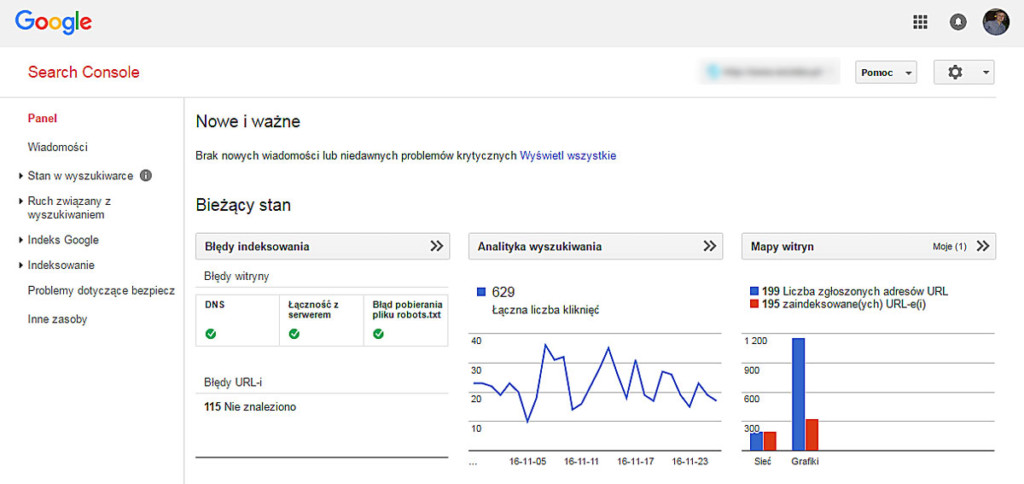
- Fewer clicks and impressions in the Performance report in Google Search Console (formerly "search queries").
- A drop in organic traffic in GA4 — in the Organic Search channel segment, not in total traffic.
- Security issues (a hacked site, injected spam) or an unexpected spike in the number of incoming links.
Fluctuations of a few to a dozen or so per cent are normal SERP volatility and do not have to mean a penalty. Only a clear, lasting slide that coincides with a specific event (a Google update or a message in Search Console) is a reason to act.
Manual action — how to check?
A manual action is a penalty imposed by a Google employee, most often after detecting unnatural links, spam or content that violates the guidelines. Its key characteristic: Google always informs you about it.
Go to Google Search Console → Security & Manual Actions → Manual actions. If you see the message "No issues detected", it means there is no manual penalty — the cause of the drop lies elsewhere (most often algorithmic). If a problem description appears, the report will indicate what it concerns (the whole site or part of it) and why it was penalised.
The most common reasons for manual actions:
- Unnatural links to your site — links bought or exchanged in bulk.
- Unnatural links from your site — selling links, spammy outbound links.
- Thin content, hidden text, keyword stuffing.
- Pure spam and sneaky redirects (cloaking).
- A hacked site — a security violation.
How to remove a manual action?
The scheme is simple in principle, though labour-intensive in practice:
- Remove the real cause. With unnatural links, first try to remove them (contact the webmasters) and only disavow the remaining ones via the Disavow tool. With content — rewrite or remove pages with no value.
- Document your actions. Collect a list of removed links, screenshots, dates — they will be useful in the request.
- Submit a reconsideration request in Search Console. Describe specifically what you fixed and how — vague statements prolong the process.
The Google team will re-evaluate the site. If the violations have genuinely disappeared, the manual action will be lifted. This is the only kind of "penalty" that can be formally "revoked".
Algorithmic drop — core updates and content quality
If there is no manual action in Search Console and your traffic dropped anyway, you are most likely dealing with an algorithmic drop. Google sends no notification here — that is the biggest difficulty in the diagnosis. Today the former standalone algorithms Penguin (links) and Panda (content quality) run continuously as part of the main algorithm, and quality evaluation is handled by systems activated during core updates.
How to confirm it is the algorithm and not something else:
- Compare the date of the drop with Google's update calendar. The company announces the start and end of every core update on the Search Status Dashboard. If your slide coincides with such a window — that is strong evidence.
- Check which pages and queries lost ground in the Performance report (comparing the periods before and after). Often a specific type of content loses, not the whole site.
- Rule out technical causes — indexing errors, an accidental noindex, a robots.txt block, a rendering problem. This is a frequent false "penalty".
How to recover traffic after an algorithm update?
With an algorithmic drop there is no "revoke" button. Regaining visibility means working on the real quality of the site, assessed during subsequent updates. Focus on what Google rewards:
- Content created for people, not for the algorithm. The helpful content system rewards material that genuinely answers a user's need. Remove or merge pages with no value, improve those with potential.
- E-E-A-T — experience, expertise, authoritativeness, trustworthiness. Show who is behind the content, give specifics and evidence instead of generalities.
- Link profile — gradually cut off toxic links, build natural and valuable ones. Do not buy links in bulk.
- Technical health and Core Web Vitals — loading speed (LCP), stability (CLS) and responsiveness (INP) affect the experience the algorithm takes into account.
- Patience. Results often become visible only at the next core update — from a few weeks to a few months. Systematic work and watching the data is the only way.
If you do not know where to start, a thorough SEO audit will locate the cause fastest — it checks the technical layer, content and links at once, so you are not guessing whether the problem sits in the code, in weak copy or in the link profile.
Table: manual action vs algorithmic drop
| Characteristic | Manual action | Algorithmic drop |
|---|---|---|
| Notification | Yes, in Search Console | None — you must detect it yourself |
| Who imposes it | A Google employee | The algorithm / a core update |
| How to reverse it | Fix + reconsideration request | Improve quality and wait for an update |
| Recovery speed | After the request is accepted | At the next update |
Frequently asked questions
Can an algorithmic penalty be "lifted" in one move?
No. An algorithmic drop is not a penalty that can be revoked. You have to remove the real causes (weak content, toxic links, technical problems), and the rankings will rebuild when the site is re-evaluated — usually during the next core update.
I dropped exactly on the day of a core update — what should I do?
Compare which pages and queries lost ground and look for a pattern (e.g. guide content or category pages are losing). Then improve the quality of those specific materials with usefulness for the user and E-E-A-T in mind. There is no point waiting for the update to be "reversed" — fix the substance.
Is every traffic drop a Google penalty?
No. The most common causes of drops are technical errors (noindex, a robots.txt block, an indexing problem), seasonality, a change in user behaviour or growing competition. You only confirm a penalty after ruling out these causes and checking Search Console.
How long does it take to regain visibility?
With a manual action — from a few days to a few weeks after the request is accepted. With an algorithmic drop — from a few weeks to a few months, because changes are verified during subsequent algorithm updates. Consistency is key, not a one-off push.
Have your rankings dropped? Let's check what really happened
At the SEMTAK Marketing Agency we diagnose the cause of the drop instead of shooting in the dark — and we point out what will genuinely recover your traffic:
- SEO audit — a full diagnosis: technology, content and links in one place.
- Website SEO — rebuilding visibility and steady growth in Google traffic.
- Online store SEO — for e-commerce after a rankings drop.
- SEO packages — choose a scope of cooperation matched to the scale of the problem.
Do you run a WooCommerce store and worry about your visibility? Start with the guide WooCommerce store SEO — where to start, and convert the lost traffic into lost revenue with the lost sales calculator.
Frequently asked questions
Can an algorithmic penalty be "lifted" in one move?
No. An algorithmic drop is not a penalty that can be revoked. You have to remove the real causes (weak content, toxic links, technical problems), and the rankings will rebuild when the site is re-evaluated — usually during the next core update.
I dropped exactly on the day of a core update — what should I do?
Compare which pages and queries lost ground and look for a pattern (e.g. guide content or category pages are losing). Then improve the quality of those specific materials with usefulness for the user and E-E-A-T in mind. There is no point waiting for the update to be "reversed" — fix the substance.
Is every traffic drop a Google penalty?
No. The most common causes of drops are technical errors (noindex, a robots.txt block, an indexing problem), seasonality, a change in user behaviour or growing competition. You only confirm a penalty after ruling out these causes and checking Search Console.
How long does it take to regain visibility?
With a manual action — from a few days to a few weeks after the request is accepted. With an algorithmic drop — from a few weeks to a few months, because changes are verified during subsequent algorithm updates. Consistency is key, not a one-off push.