SEO Product Descriptions — How to Write Copy That Sells and Ranks

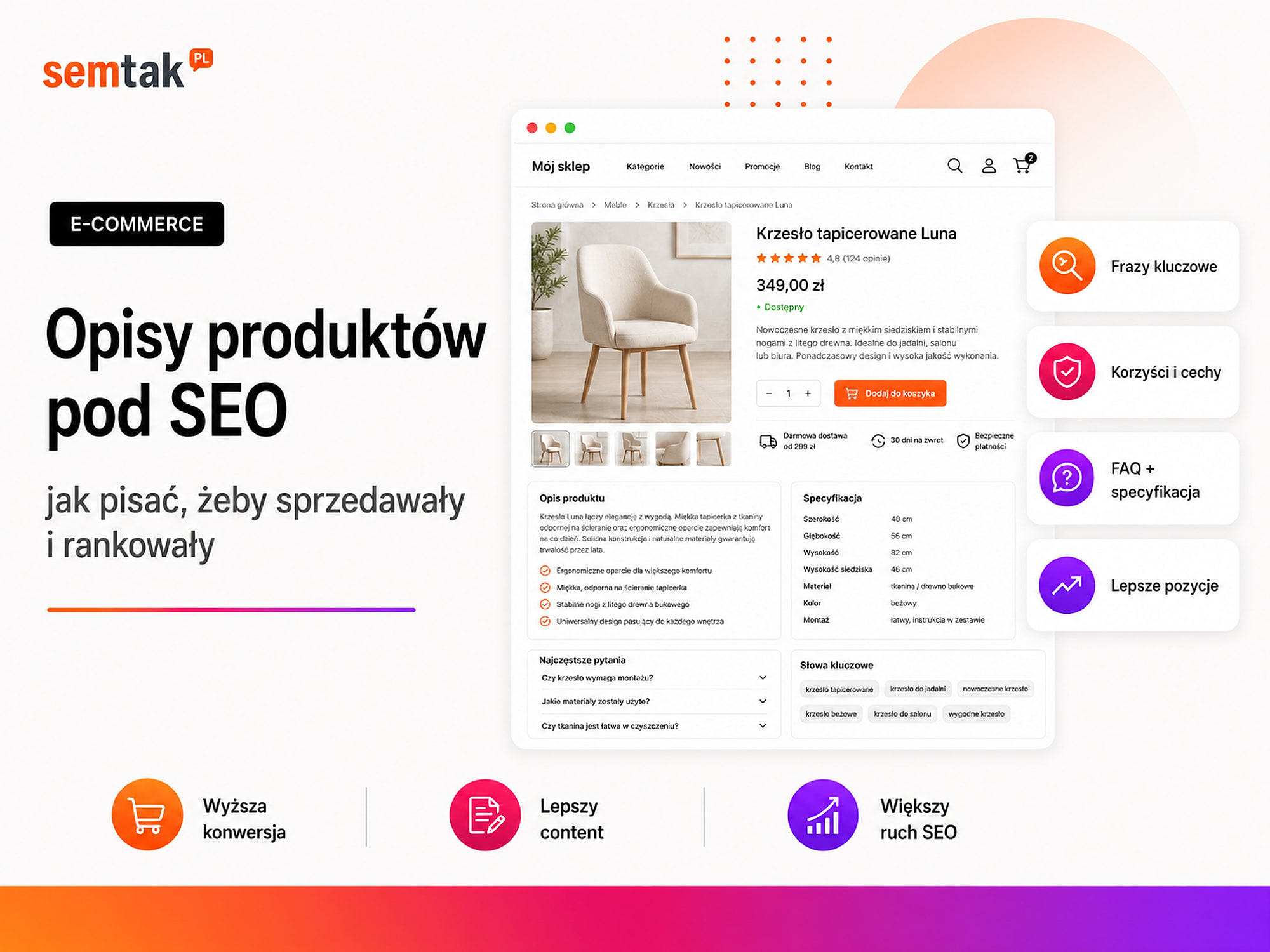
A good SEO product description has two jobs. It helps the customer decide whether the product matches their needs, and at the same time gives Google the data it needs to understand the product page.
The problem starts when a description is written purely around a keyword. The phrase comes back in every paragraph, the text balloons to a random 1,500 words, and the customer still doesn't know whether the chest of drawers will fit into the alcove, what the fronts are made of and whether the furniture requires assembly.
In short
A good SEO product description does two jobs at once: it helps the customer make a decision and gives Google the data to understand the product page. Write concretely — dimensions, materials, use cases, how the product differs from others — instead of stuffing the keyword into every paragraph. Use the keyword naturally in the title, heading and description, but the human comes first: a description that answers real questions sells and ranks better than text written "for the robot".
At a glance (TL;DR)
- A good product description answers the customer's questions first. SEO keywords should come from the product's real features and use cases.
- The manufacturer's description can be a source of data, but publishing it without your own information gives your page no edge over the competition.
- A product page should answer a precise intent, e.g. a specific model, dimension, material or use case.
- The most important elements of a description are: a quick explanation of the product, benefits, specifications, limitations, delivery and answers to questions.
- With a large catalogue, start with the products that bring the most revenue, margin, traffic or sales potential.
- AI can speed up writing descriptions, but it must not invent specifications, compatibility or product properties.
What is an SEO product description?
An SEO product description is content that helps the customer evaluate the product while clearly telling the search engine what the page is about.
It is not about placing the same phrase five or ten times. A good description combines four elements: customer intent (what they are looking for and what problem they want to solve), product information (materials, dimensions, features, use cases and limitations), sales arguments (why this particular product may match their needs) and SEO elements (the right keywords, headings, linking, metadata and described images). If the information the customer needs is missing, using keywords alone won't help — the product may get impressions but not sell, because after landing on the page the user won't get answers to their basic questions.
The description is not a separate text "for the robot". Don't create two layers — a short description for the customer and a long block of keywords hidden at the bottom of the page. Google and the customer analyse the same page; the safest approach is one readable description that naturally combines product information with the language buyers use.
Product description or category description — where should the keyword go?
A product page should answer a query about a specific model or variant, and a category page should answer a query covering a group of products.
| Keyword | Better landing page |
|---|---|
| chests of drawers for the living room | Category |
| oak chests of drawers | Category or subcategory |
| oak chest of drawers 150 cm | Product or a precise subcategory |
| Diana chest of drawers 150 cm white | Specific product page |
| furniture for a small living room | Category or a guide |
| how to choose a chest of drawers for the living room | Guide article |
If a user searches for "chests of drawers for the living room", they probably want to compare several models — sending them straight to a single chest of drawers may miss what they were looking for. On the other hand, someone typing a specific model, dimension or code is usually closer to buying, so the right page is the product page.
One product page — one main intent. Don't try to rank a single product simultaneously for chests of drawers, living room furniture, bedroom furniture, white furniture, cheap furniture and home furnishings. Choose the main intent based on the product's real features — the other terms can appear in the description as context. More on splitting keywords and building categories in our guide to WooCommerce category architecture for SEO.
Does a copied manufacturer description hurt SEO?
A manufacturer's description doesn't trigger an automatic penalty, but it usually gives neither Google nor the customer a clear reason to choose your store.
The same description in 20 stores doesn't make your page stand out
The manufacturer's text appears on the manufacturer's site, at the wholesaler, on marketplaces and in many stores — your page adds little beyond what already exists elsewhere. The problem isn't only repetition: manufacturer descriptions often use technical language, focus on the brand instead of the customer's need, don't show use cases, don't explain limitations, don't answer the questions customers ask support, and don't cover delivery and return conditions.
How to use the manufacturer's description. Treat it as a source of data — materials, dimensions, composition, certificates, manuals, compatibility, warnings and usage information. Then add your own layer: who the product is for, when it's worth choosing, how it differs from similar models, what the specifications mean in practice, what its limitations are, what's included in the box and what customers most often ask about. Don't change specifications just to make the text look unique — dimensions, materials and composition must stay consistent with the documentation.
Where to start when writing a product description?
First gather complete data and customer questions. Only then start structuring the content.
Don't guess materials, dimensions, compatibility, maximum load, box contents, assembly method or warranty terms — if the input data is incomplete, the description quickly turns into a set of generalities. Prepare a product data sheet:
| Area | Example information |
|---|---|
| Name | Model, series and variant |
| Product type | Chest of drawers, cream, wall lamp, cable |
| Material | MDF, steel, cotton, plastic |
| Dimensions | Width, height, depth |
| Variants | Colour, size, capacity |
| Use case | Room, device, type of user |
| Limitations | Maximum load, not waterproof |
| Box contents | Product, manual, accessories |
| Assembly | Pre-assembled or self-assembly |
| Delivery | Number of parcels, oversized item, lead time |
| Warranty | Length and basic terms |
| Identifiers | SKU, EAN, GTIN, manufacturer code |
| Documentation | Manual, technical sheet, certificate |
Use the knowledge from customer service. Review e-mails, phone calls, chat logs, questions from marketplaces such as Amazon or eBay, reviews, complaints, return reasons and questions asked of sales staff. If customers regularly ask whether the furniture requires assembly, the answer should be visible on the product page. If a product is often returned because of the wrong shade, you need a better colour description or more accurate photos.
How to find keywords for a product description?
Keywords should come from the product's name, specifications and use case, and from the words customers use.
Establish what the manufacturer calls the product, what your team calls it, how the customer searches for it, which features matter during purchase, what the product must be compatible with and in what situation it will be used. Where to check customer language: Google Search Console, your store's internal search, the Google Ads search terms report, customer questions, marketplace queries, Google results, search suggestions, competitors' product pages and the manufacturer's documentation. In Search Console you'll find the queries for which the page already gets impressions — but don't add every phrase; first check whether it actually describes the product.
Main keyword and supporting keywords. Example product: a white chest of drawers, 150 cm, with three drawers and gloss fronts. Main keyword: "white chest of drawers 150 cm". Supporting keywords: white gloss chest of drawers, chest of drawers with three drawers, 150 cm chest of drawers with shelves, modern chest of drawers for the living room, white MDF chest of drawers. All of them come from real features — don't use "solid wood chest of drawers" if the body is made of laminated board.
Long-tail keywords. Long-tail means more precise queries, e.g. "white chest of drawers 150 cm with three drawers", "height-adjustable desk 120 × 65 cm with memory presets", "TV cabinet with electric fireplace 150 cm", "black steel G9 wall lamp with two light sources". They have a narrower meaning than "chest of drawers" or "desk", but they match a specific product page much better.
Where to place the SEO keyword?
The main keyword should appear in the most important elements of the page, but only where it sounds natural.
It's usually worth using it in the product name/H1, the URL, the meta title, the short description, the first paragraph, an appropriate heading, the alt text of the right image and natural internal links. Not every element has to contain the identical form of the phrase. Example: H1 "Diana chest of drawers 150 cm — white, gloss fronts"; URL /diana-chest-of-drawers-150-cm-white-gloss/; meta title "White Diana chest of drawers 150 cm with 3 drawers"; opening of the description "The Diana chest of drawers is 150 cm wide, with three drawers and shelves behind closing fronts".
Don't stuff keywords
Bad: "The white chest of drawers 150 cm is a modern white chest of drawers 150 cm for the living room. Our white chest of drawers 150 cm is the best white chest of drawers 150 cm." Good: "The Diana chest of drawers is 150 cm wide, with three drawers and shelves hidden behind the fronts. The white finish brightens the room, and the wide top gives you space for decorations, a lamp or AV equipment." The second version conveys more information and sounds natural.
What should the structure of a product description look like?
A good structure leads the customer from a quick explanation of the product through benefits and specifications to resolving their final doubts. Not every product needs all sections — match the description to the price, complexity and risk of a wrong purchase.
1. A short explanation at the top. The first two or three sentences should say what it is, who it's for, what it's used for and what its main advantage is. Example: "The Diana chest of drawers 150 cm works well in a living room or bedroom where you need space for clothes, documents and small items. Three drawers help separate smaller things, and the shelves behind closing fronts hold larger accessories".
2. The key benefits. Don't limit yourself to a list of features:
| Feature | What does it mean for the customer? |
|---|---|
| Three drawers | Easier separation of documents, textiles and small items |
| MDF front | An attractive, stable front surface |
| Soft-close system | Gentler closing without slamming |
| Height adjustment | Working both seated and standing |
| Three-position memory | Quick return to a saved height |
Pattern: feature → practical meaning → usage situation
Instead of a dry feature, show what it gives the customer and when. Example: "The 120 cm wide desktop fits a laptop, an extra monitor and basic accessories, yet takes up less space than a typical 160 cm desk. It will therefore work well in a small home office or a teenager's room." This pattern turns a list of specifications into a buying argument and reduces the risk of a wrong choice.
3. Use case and fit. Explain where and for whom the product is suitable — the room, the way it's used, the type of user, compatible devices, operating conditions, the amount of available space. Example: "This model is suitable for working with a laptop or a single monitor. If you use two large screens and an extensive docking station, consider a wider desktop".
4. Technical specifications presented in a readable table:
| Parameter | Value |
|---|---|
| Width | 150 cm |
| Height | 82 cm |
| Depth | 40 cm |
| Body material | Laminated board |
| Front material | MDF |
| Number of drawers | 3 |
| Closing system | Soft-close |
| Assembly | Self-assembly |
Don't bury the most important data in a long paragraph. If you use specialist labels, explain them immediately — e.g. the IP rating describes resistance to dust and water.
5. Product limitations. Honestly describing limitations builds trust and reduces returns: the product requires self-assembly, the desktop is not suitable for outdoor use, the colour may look different depending on the monitor, the cable doesn't support a given standard, the furniture is delivered in several heavy parcels, the product doesn't include an item shown in the styled photo. Don't try to present every limitation as an advantage — state plainly what the customer should know before buying.
6. Delivery, assembly and box contents. Explain what's included, how many parcels the customer will receive, whether extra tools are needed, whether the product requires assembly, whether a manual is included, whether delivery includes carrying the item inside and what the expected lead time is. For furniture, electronics and technical products, this information directly affects the decision.
7. A product FAQ should answer real questions: is the chest of drawers delivered assembled, can the front be mounted on the other side, is the decor colour identical to another manufacturer's, does the cable fit a specific model, what is the maximum load, does the set include fixings. Don't add questions just to repeat the SEO keyword.
Example of a weak and a strong product description
A weak description sounds like this: "A modern, high-quality chest of drawers that will work perfectly in any interior. The product is made from the finest materials. Its unique design will satisfy the most demanding customers." This text gives no specifics, could describe any chest of drawers, contains no dimensions, shows no use case, explains no differences and makes promises without backing them up.
A better description:
The Diana chest of drawers is 150 cm wide and offers three drawers plus shelves behind closing fronts. This lets you separate documents and small items from larger things such as textiles, tableware or household accessories. The white gloss fronts reflect light and suit contemporary living rooms and bedrooms; the body has a matt finish, so the difference between the surfaces is visible up close. The model is delivered in flat-pack parcels for self-assembly — before ordering, measure not only the spot by the wall but also the width of your doors, hallway and staircase.
The second description is better not because it has more words — it simply contains the information the customer needs.
How long should a product description be?
A description should be as long as an informed purchase decision requires. There is no single word count that fits all products.
Length depends on the price, the product's complexity, the number of specifications and variants, the risk of a mistake, customer questions, the need for assembly and the differences between models. A short description may be enough for a simple product (a cable with unambiguous compatibility, a replacement refill, a standard part, a simple accessory, a product regularly bought by returning customers) — two or three sentences, a specifications table, a list of compatible devices and information about the box contents will do. A longer description is needed for a product that is expensive, technical, made to order, requires assembly, comes in many variants, has important limitations, is often returned or needs model comparison — and it should still be readable, broken into headings, tables, lists and short paragraphs.
Should the description sit above or below the "Add to cart" button?
The most important purchase information should sit close to the price and the button, while more detailed content can go lower down.
In the upper part of the page show the name, the main benefit, the price, variants, availability, dispatch time, basic delivery information and the buy button. Below that, place the full description, use cases, the specifications table, the manual, the FAQ, reviews and related products. Don't force the customer to read a long text before seeing the price and availability. Tabs and collapsible sections are fine to use if they work properly on a phone, have clear labels, don't hide essential information, can be operated with a keyboard and the content is present in the page's source code. The key question: can the customer find the answer quickly.
How to write a product meta title and meta description?
The meta title should unambiguously identify the product, and the meta description should encourage opening the page.
The meta title can include the product type, brand or model, an important dimension, the variant and the key feature: "Diana chest of drawers 150 cm white — 3 drawers", "Varius desk 120 × 65 cm — height adjustment", "Marea G9 wall lamp black — 2 light sources". Don't try to fit every possible keyword into the title. The meta description should answer the question "why open this particular page?" — e.g. "White Diana chest of drawers 150 cm with three drawers and shelves. Check the dimensions, materials, assembly method and delivery time". Google may display a different snippet if it considers it a better match, but it's still worth writing a meta description, because it gives you the chance to propose your own message.
How to prepare the product name and URL?
The name should clearly identify the product, and the URL should be short, readable and stable.
A good name can include the product type, model, dimension, colour, material and an important variant: "Diana chest of drawers 150 cm — white, gloss fronts" is better than "Chest of drawers white modern cheap for living room bedroom 150 cm gloss drawers". A good URL: /diana-chest-of-drawers-150-cm-white-gloss/; a bad one: /product?id=5382&cat=14&color=white/. Don't change a published URL with every name tweak — if you must change the URL, set up a 301 redirect and update internal links, the product feed and your ad campaigns.
How to describe product variants?
Standard colours and sizes should usually remain variants of a single page. Separate URLs only make sense when the variants answer different needs.
One page is usually right when variants differ only in colour, size, capacity or a simple finish. Separate pages can make sense when variants have a different use case, answer separate queries, have different specifications, have their own photos and descriptions, are promoted independently or are treated by the warehouse as distinct products. If a variant has its own URL, it should show a matching photo, price, name, availability, description and structured data. Don't create hundreds of nearly identical pages where only the colour name changes.
Product photos and description SEO
Photos should answer the questions that are hard to explain well with text alone.
Depending on the product, show it from several angles, material details, the product's scale, how it's used, dimensions, box contents, variants, the assembly method and the packaging. Alt text: the alt attribute describes the image content to people using screen readers and helps the search engine understand the image. Good: "White Diana chest of drawers 150 cm with three drawers — front view". Bad: "chest of drawers white chest of drawers 150 chest of drawers for living room cheap chest of drawers gloss". Each photo can get a different description if it shows a different detail — don't put keywords in the alt text of purely decorative elements.
Product description vs structured data
The description is content for the customer, while structured data passes organised information about the product and the offer to the search engine.
A product page can include types such as Product, Offer, Review and AggregateRating — they can convey the price, currency, availability, brand, SKU, GTIN and review data. The information in structured data must match what the customer sees — don't declare a different price, availability or ratings than those on the page. We cover the detailed implementation in our article on WooCommerce product structured data — Product, Offer and Review schema.
Customer reviews as an extension of the description
Reviews complement the description with customer experience, but they shouldn't replace the basic information prepared by the store.
Reviews can show the product's real shade, the difficulty of assembly, how a size fits or how the product performs after a few months. If the same doubt keeps recurring in reviews, improve the main description too. More in our guide to product reviews and ratings in WooCommerce — SEO, stars and UGC.
How to link from a product page?
Linking should make it easier for the customer to compare the offer or find the information needed to buy.
You can link to the parent category, similar models, matching accessories, products from the same collection, manuals, size charts, a buying guide, delivery terms and return information. Example anchors: "see the other white chests of drawers", "compare height-adjustable desks", "check the size guide", "learn how to care for wood". Don't add a pile of random links just because "linking helps SEO".
How to write descriptions in a store with thousands of products?
With a large catalogue you need priorities, organised data, templates and quality control — don't start describing products in the order of their database IDs.
| Group | Characteristics | Scope of work |
|---|---|---|
| A | Highest revenue, margin or SEO potential | Full, individual description |
| B | Stable sales and moderate potential | Extended template with manual editing |
| C | Low traffic and many similar products | Shorter, data-driven description |
| D | Discontinued products or no demand | Update, merge or remove |
With a catalogue like this, product prioritisation, the keyword map and the description workflow can be set up as part of online store SEO — so the work starts with the pages that have a real chance of bringing traffic and sales.
Prepare templates for product types. A chest-of-drawers template may need fields for: width, height, depth, body material, front material, number of drawers, number of shelves, opening mechanism, assembly, number of parcels. A lamp template needs different data: number of light sources, socket type, maximum wattage, voltage, IP rating (resistance to dust and water), material, colour, dimensions, whether a bulb is included. A template is there to organise data — it should not generate identical paragraphs with only the name swapped.
Don't manufacture artificial uniqueness. Bad: "Chest of drawers A is 150 cm wide. Chest of drawers B stands out with a width of 150 centimetres. Chest of drawers C offers a width dimension of 150 cm." That's the same information rewritten three ways. Real value comes from different use cases, construction differences, genuine comparisons, limitations, customer questions, manuals and the right photos.
Can you write product descriptions with AI?
AI can prepare a draft and speed up the work, but it needs verified data and human oversight.
The problem isn't using the tool itself — the problem appears when a store mass-publishes content that is generic, repetitive, unverified, misleading or written without knowing the product. A safe process: gather complete data → define the customer group and use case → prepare the description structure → add an approved glossary of terms → generate a draft → check every specification → remove generalities and unsubstantiated promises → compare the description with the price, variants and photos → read the page on a phone → approve the content before publishing.
AI must not invent specifications
The most common AI mistakes: an invented material, wrong compatibility, a feature the product doesn't have, a fake certificate, incorrect box contents, mixed-up variants, identical passages on many pages, and medical or legal claims without basis. If the manufacturer doesn't state the maximum load of a chair, AI must not fill it in based on similar products — an unverified specification in a description is a direct risk of returns, complaints and liability.
How to roll out product descriptions step by step?
Run the rollout from store structure and priorities, through data and intent, to the technical layer and measurement.
Step 1. Organise the store structure — decide which keywords lead to categories and which to products. Our guide WooCommerce SEO — where to start will help. Step 2. Pick priority products — those generating the most revenue, with high margins, getting lots of impressions, promoted in Google Ads, seasonal, frequently searched for and generating lots of questions. Step 3. Gather the data — specifications, photos, manuals, limitations, customer questions and return reasons. Step 4. Choose the main intent — one main keyword and a group of natural supporting keywords. Step 5. Write the opening for the customer — what it is, what it's for, who it suits.
Step 6. Connect features with benefits — show what each specification means in everyday use. Step 7. Cover the key objections — assembly, dimensions, compatibility, delivery, box contents, limitations. Step 8. Prepare the metadata and photos — meta title, meta description, URL, file names, alt text. Step 9. Check the technical layer — canonicals, indexing, variants, structured data, speed, the mobile version, internal linking. Step 10. Publish and measure the result — don't judge the change after one day; compare visibility, clicks, customer behaviour and sales over a longer period.
How to measure whether a product description works?
Judge a description's effectiveness by visibility, user behaviour and sales — not just the position of a single keyword.
Visibility in Google: impressions, clicks, CTR, queries, average position, the number of keywords leading to the product (CTR shows what percentage of people clicked the result after seeing it). Behaviour on the page: product views, add-to-carts, variant selections, checkout entries, clicks on the specification, FAQ opens, page exits. Sales: number of orders, conversion rate, revenue, margin, number of returns, pre-purchase questions. Don't assume every change comes solely from the description — prices, availability, ads or the season may have changed at the same time. Record rollout dates and compare periods that are as similar as possible.
The most common product description mistakes
The most damage is done by: copying from the manufacturer, writing purely for the keyword, missing specifications and mismatches with the feed.
1. Copying the manufacturer's text — the page adds no context of its own and looks like the competition. 2. Writing purely for the keyword — the phrase recurs in every paragraph while the customer doesn't get the information they need. 3. Missing specifications — the buyer can't check dimensions, material, compatibility or box contents. 4. Specifications without explanation — the customer sees "IP44", "16 mm MDF" or "1000 lumens" but doesn't know what it means in practice. 5. Hiding limitations — information about assembly, lack of waterproofing or incompatibility only appears after purchase. 6. The same content for variants — separate colour/size pages have identical descriptions, photos and metadata.
7. Mismatch with the product feed
When the name, price, variant or availability differ between the page and Google Merchant Center, the product may be rejected or show an outdated offer. The price and availability in the feed, on the page, in structured data and at checkout must match. Data consistency is especially important for Google Shopping campaigns.
What can you check yourself?
You'll learn the most by opening your most important products on a phone and comparing them with the competition.
- Open your five most important products on a phone.
- Check whether you understand within seconds what is being sold.
- See whether the key specifications are easy to find.
- Search a fragment of the manufacturer's description in quotation marks in Google.
- Check the product's queries in Search Console.
- Compare the page with three competitors.
- Write down the questions the description doesn't answer.
- Verify the dimensions, materials and box contents.
- Check the meta title and meta description.
- Review the images' alt text.
- Check the product's structured data.
- Compare the price and availability with Merchant Center.
- Set product views against add-to-carts.
- Review questions to support, returns and complaints.
- Make sure a long description doesn't push the price and buy button out of view.
When is it worth bringing in a specialist?
A specialist makes sense when the store has a large catalogue, messy data, or products that get traffic but don't generate sales.
It's worth commissioning an analysis when descriptions are copied from a feed or wholesaler, the store has thousands of products, it's unclear which pages to develop first, categories and products compete for the same keywords, products get impressions but few clicks, pages get traffic but few add-to-carts, imports regularly overwrite descriptions, variants create many similar URLs, structured data contains errors, Merchant Center rejects products, you need an AI-based description workflow, or the content has to be produced in several languages. A good project doesn't start with writing 10,000 texts — first you need to check the architecture, the data, the products' potential and how the content will be kept up to date. A good starting point is an SEO audit of the store, which will show whether the problem lies in the descriptions, the structure, indexing, linking or the technical layer.
Frequently asked questions
Does every product need a unique description?
Every important page should add its own value. You don't have to artificially rewrite identical specifications. Differences can come from use cases, benefits, limitations, model comparisons and customer questions.
How long should an SEO product description be?
There is no single required word count. A simple product may need a few sentences and a table, while an expensive or technical model needs a longer explanation. Match the scope to the decision the customer has to make.
Does a manufacturer's description trigger a Google penalty?
It doesn't trigger an automatic penalty. The problem is that many stores publish identical text, so your page adds no extra value and finds it harder to stand out in the results.
How many times should the main keyword appear in a product description?
There is no required number. Use it naturally in the name, the opening of the description and the right page elements. Don't repeat the phrase just to hit a specific density.
Can product descriptions be generated with AI?
Yes, but the AI should work from verified data and an agreed structure. Every text must be checked for specifications, promises, variants and consistency with the offer.
Is a technical specification enough instead of a description?
Not always. A specification shows the parameters but doesn't explain what they mean in use or who the product suits.
Do separate variants need separate descriptions?
Only when they have their own URLs and genuinely differ in a way that matters to the customer. Standard colours and sizes are usually better left as variants of a single page.
Does a product description affect sales?
It can support sales if it answers questions and reduces uncertainty. It won't, however, fix a bad price, lack of availability, a broken payment process or an unattractive offer.
A description should help people buy, not just rank
An SEO product description should not be a block of text written solely for the search engine. Its job is to help the customer understand the product, judge the fit, check the specifications and make a decision — while clearly telling Google what product is on the page and which precise queries it answers.
First organise the store structure and gather reliable data. Then prepare content that answers the buyer's questions, add natural keywords and check the whole page — from photos and metadata to variants and structured data. After publishing, measure not only rankings but also clicks, add-to-carts, sales and returns. If you want to find out which pages have the most potential and why they aren't making the most of their current traffic, we can analyse your descriptions, keywords, structure and customer behaviour:
- Online store SEO — content development priorities without rewriting the entire catalogue blind.
- SEO audit of the store and category architecture for SEO — diagnosis and structure.
- Product structured data and product reviews and ratings — completing the product page.