
This is an SEO glossary from A to Z — we have gathered more than 100 terms from search engine optimisation, website optimisation and search marketing, explained in plain language. If you are looking for a specific term, press CTRL + F and type the phrase you need. We keep the definitions up to date with new phenomena: AI Overview, GEO, Core Web Vitals and E-E-A-T. If you need real results rather than theory, take a look at our website SEO services and online store SEO.
A
Alt attribute
The alt attribute is a text description of an image in HTML code, displayed when the image cannot be loaded. It has a strong impact on visibility in image search — Google's robots cannot "see" what is in a photo, so this attribute describes it for them. It also plays an important role in accessibility (screen readers).
Nofollow attribute
The nofollow attribute is an instruction in HTML code telling robots not to pass link equity to the target page. It is used, among other things, for advertising and sponsored links. Today Google also distinguishes the values rel="sponsored" (paid links) and rel="ugc" (user-generated content).
SEO agency
An SEO agency is a company providing search marketing services: website optimisation, search engine positioning, Google Ads campaigns and other forms of online promotion. SEMTAK Marketing Agency specialises in the technical SEO of WooCommerce stores.
Anchor text
Anchor text is the visible, clickable text of a link. In HTML code it is the content between the <a></a> tags. A well-chosen anchor describes what the user will find after clicking and acts as a topical signal for the search engine. Stuffing anchors too aggressively with keywords, however, may be treated as manipulation.
AI Overview (AI Overviews)
AI Overview is an answer generated by artificial intelligence displayed at the top of Google's results, above the classic links. It is a synthesis of content from multiple pages, with references to its sources. Presence in AI Overview depends on content quality, clear structure (direct answers, headings, lists) and the credibility of the source. Optimising for such answers is described under the term GEO.
SEO audit
An SEO audit is an analysis of a website in terms of its visibility in search engines. It checks whether the site is well optimised technically and adapted to users and search engines, and it also examines the inbound link profile. The result is delivered as a report with a list of issues and specific recommendations on how to fix them. See our SEO audit.
B
Ban
A ban is the highest search engine penalty for using forbidden positioning techniques — the site is completely removed from the index and no longer appears in the results. You can easily check this by typing site:yourdomain.com into Google: no results may mean the site is not being indexed.
Black Hat SEO
Black Hat SEO refers to techniques forbidden by search engines, used for a quick ranking gain. When detected, they usually result in a drastic drop in visibility, a filter or a ban. The opposite is White Hat SEO.
Bot
A bot is a search engine program (robot) that visits pages and downloads their content. Google's bots return to a website from time to time to refresh its picture in the index. See also: Crawler, Googlebot, Spider.
Buzz marketing (word-of-mouth marketing)
Buzz marketing is promotion based on taking part in discussions (forums, groups, comments) and naturally referring to a brand or product. When overused and undisclosed, it may be treated as spam.
Bridge Page
Bridge Page — see: Doorway Page.
C
Google cache
Google cache is a copy of a page stored in Google's archive from the moment of the robot's last visit. It used to let you see how the search engine "saw" a page — Google has significantly restricted access to this feature, but caching itself, for indexing purposes, remains part of how the search engine works.
Citation Flow (CF)
Citation Flow is a Majestic metric on a 0–100 scale describing the strength (volume and potential) of links pointing to a page. It is best interpreted together with Trust Flow — raw "strength" without trust means very little.
Cloaking
Cloaking is a Black Hat SEO technique that consists of showing one version of content to robots and another to users. It is unambiguously forbidden and penalised.
Consent Mode v2
Consent Mode v2 is a Google mechanism that passes information about the user's consent to cookies and tracking to tools such as GA4 and Google Ads. In the European Economic Area it is practically required to collect data in line with GDPR and to measure conversions correctly. It is usually implemented through a consent management platform (CMP) connected to Google Ads campaigns and analytics.
Content marketing
Content marketing is marketing based on publishing content that is valuable to the audience — articles, guides, video materials. Done well, it builds reach, trust and natural links, and today also increases the chances of being cited in AI Overview.
Core Web Vitals
Core Web Vitals are a set of Google metrics measuring the real experience of using a page. The main metrics are LCP (the time it takes to render the largest element), INP (Interaction to Next Paint — the page's responsiveness to user actions, which replaced the earlier FID) and CLS (layout stability). Poor Core Web Vitals hurt conversion and can act as a ranking signal. If you run a store, see how to speed up a WooCommerce store.
Crawler
Crawler — see: Bot.
Content
Content is everything on a page available to the user: text, graphics and video, as well as "behind-the-scenes" elements such as the page title or alt descriptions. Valuable, unique content is today the foundation of both SEO and visibility in AI.
D
Doorway Page (Gateway Page, Bridge Page, Zebra Page, Entry Page, Jump Page)
A Doorway Page is a page created for specific phrases solely to redirect the user elsewhere. Google treats such pages as spam and penalises their use.
Dead link
A dead link is a link that does not lead to a working resource — mistyped or pointing to a deleted page. After clicking, it usually returns a 404 error. Dead links hurt the user experience and waste crawl budget.
Description (meta description)
Description is a meta tag with a short summary of the page's content. The search engine may show it below the title in the results, although it often generates its own description that better matches the query. A well-written meta description increases the click-through rate (CTR).
Domain Authority (DA)
Domain Authority is a Moz metric on a 1–100 scale estimating the "strength" of a domain compared to others. It is an indicative measure that does not come from Google — it helps compare domains, but it is not an official ranking factor.
Duplicate content
Duplicate content is the same content appearing under multiple URLs — within a single website or copied from another one. It makes it harder for the search engine to choose which version to index and dilutes ranking signals. The solution is usually the canonical tag and tidying up URLs. It is a common problem in online stores — see WooCommerce store SEO — where to start.
Duplicate Content Penalty
Duplicate Content Penalty is the colloquial name for the negative effects of duplicating content. In practice, rather than an actual "penalty", what usually happens is the filtering of duplicated pages and the selection of one version to display.
Duplicate Content Filter
Duplicate Content Filter is a search engine mechanism that omits pages with duplicated content from the results, most often by not including them in the main index.
E
E-E-A-T
E-E-A-T stands for Experience, Expertise, Authoritativeness, Trust — criteria from Google's quality rater guidelines for assessing page quality. Content created by real experts, with clear authorship, sources and tangible experience, has a better chance of ranking highly and being cited by AI. It is an extension of the earlier E-A-T with the "Experience" factor.
Entry Page
Entry Page — see: Doorway Page.
F
FSB (Fresh Site Bonus)
FSB is the observed phenomenon of new sites temporarily ranking higher in the results. Once it wears off, positions return to the level justified by the site's real quality and authority. The end of FSB should not be confused with a filter.
Filter
A filter is an algorithmic sanction applied when unethical methods are suspected — for example, lowering the positions of selected pages. It is usually temporary and lifts once the cause is removed.
Keyword phrase
A keyword phrase is a group of semantically related words describing what the user is looking for (e.g. "online store development"). Selecting and grouping phrases is the foundation of every SEO strategy.
G
Gateway Page
Gateway Page — see: Doorway Page.
GEO (Generative Engine Optimization)
GEO is the optimisation of content for generative engines and AI answers (AI Overview, ChatGPT, Perplexity, Gemini) so that your site gets cited by them. What matters here: clear direct answers, data and facts, structure (headings, lists, FAQ), structured data and credibility (E-E-A-T). GEO complements classic SEO; it does not replace it.
Googlebot
Googlebot is Google's robot that indexes pages, assesses the usefulness of content and influences its position in the results. It operates in desktop and mobile variants (the mobile version is the priority today).
Google Analytics (GA4)
Google Analytics is Google's free tool for analysing traffic and user behaviour. The current version is the event-based GA4, which replaced the earlier Universal Analytics. It lets you check where your customers come from and what they do on the site — and then improve its effectiveness. Implementation is best combined with Google Ads campaigns and Consent Mode v2.
Geolocation
Geolocation is determining the user's location in order to match results more accurately. That is why, when searching for a "mechanic" in Manchester, you will mostly see businesses from the area. It is the foundation of local SEO.
Deep linking
Deep linking is building links that lead to specific subpages (not just the homepage). It positively affects the visibility of the linked resources and looks natural.
Google Ads
Google Ads (formerly Google AdWords) is Google's advertising system that lets you display paid ads in search results, across the partner network, and in Gmail and YouTube. Billing is based on clicks (CPC) or impressions (CPM), among other models. More about our services: Google Ads.
Google Bomb
A Google Bomb is a Black Hat SEO technique of mass-linking a page with anchors unrelated to its content in order to rank it for a humorous or manipulative phrase. Modern algorithms neutralise it effectively.
Google Merchant Center
Google Merchant Center is a platform for submitting a product feed with your store's data, powering product ads. It is the basis for Google Shopping campaigns that display product photos, prices and names.
Google Business Profile (Google My Business)
Google Business Profile (formerly Google My Business) is a free business listing visible in Google Maps and local results. It lets you collect reviews and ratings and present contact details — crucial for local SEO.
Google News
Google News is a service aggregating news content from selected sources, allowing you to follow current publications.
Google Search Console
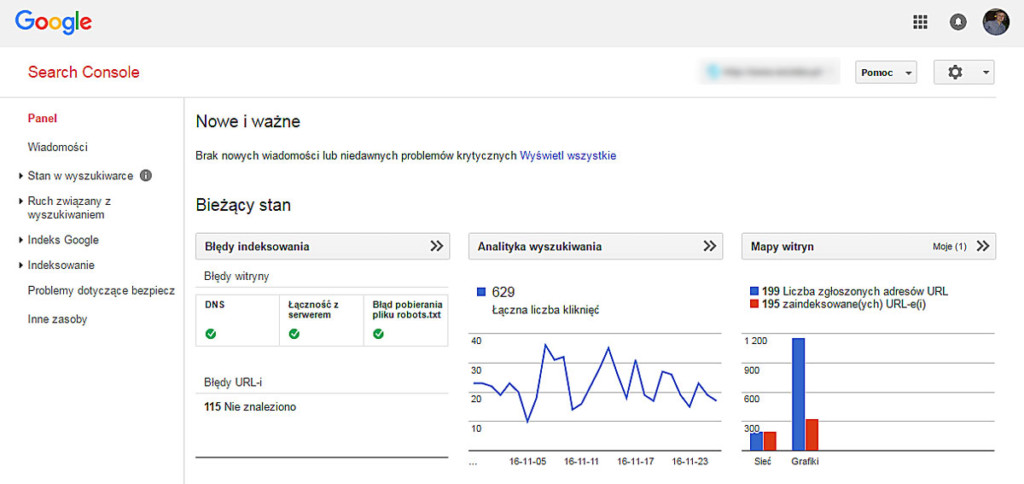
Google Search Console (formerly Google Webmaster Tools) is Google's free tool showing how the search engine sees your site: indexing status, queries, clicks, errors and Core Web Vitals. Every website owner should be using it.
Gray Hat SEO
Gray Hat SEO refers to techniques on the borderline between White and Black Hat — hard to classify unambiguously and carrying a certain amount of risk.
H
Helpful Content
Helpful Content is Google's approach that promotes content created first and foremost for people — genuinely answering the user's need, based on experience and knowledge. Content written purely "for the algorithm", with no added value, loses visibility. The "people-first content" principle is now built into the core ranking algorithm.
Hreflang
Hreflang is an attribute that tells the search engine which language and region a given version of a page is intended for. Correct implementation prevents serving the wrong language version and duplication problems between versions.
I
IBL (Inbound Links, backlinks)
IBL are inbound links pointing to a given page from other websites. Their number, and above all their quality, are among the most important factors influencing rankings.
Indexing
Indexing is the process of adding and updating information about a page in the search engine's database by its robots. Searching means querying exactly this index — a page outside it will not appear in the results.
Inbound Links
Inbound Links — see: IBL.
INP (Interaction to Next Paint)
INP is a Core Web Vitals metric measuring page responsiveness — the time from a user interaction (e.g. a click) to a visible interface response. In 2024 it replaced the FID metric. A high (bad) INP indicates "heavy" JavaScript blocking the page.
Invisible text
Invisible text is text hidden from the user but visible to robots — usually stuffed with keywords and masked with the background colour or CSS. It is a forbidden, severely penalised technique.
J
Jump Page
Jump Page — see: Doorway Page.
K
Web directory
A web directory is a thematically organised service collecting links to other websites with descriptions. A former source of links, today mostly worthless or harmful — not worth building a strategy on.
Directory submission
Directory submission means placing links to a site in web directories. Nowadays an outdated technique; mass entries in low-quality directories can harm the link profile.
Keyword density
Keyword density is the share of keywords in the entire content of a page. Rigidly "chasing a percentage" is outdated today — what counts is natural, complete text that answers the query.
Keyword stuffing
Keyword stuffing is the unnatural "cramming" of keywords into content and tags to focus the robots' attention on them. It is a Black Hat SEO technique that, instead of helping, worsens both readability and rankings.
Keyword positioning
Keyword positioning is the deliberate placement of phrases in the key spots of a page — the title, headings, body content and image descriptions — so as to signal the topic in a natural way.
Hummingbird
Hummingbird is a Google algorithm focused on understanding the intent and context of a query, not just word matching. It paved the way for today's semantic search and AI answers.
L
Landing page
A landing page is a page built for a single goal — most often an advertising campaign. It focuses on one product, service or action (sign-up, purchase, contact) and is optimised for conversion.
Link
A link is an HTML element directing the user to another subpage or website. For SEO, internal, inbound and outbound links all matter.
Link farm
A link farm is a group of sites that exist solely to mass-produce links — a Black Hat SEO technique, easy to detect and penalised.
Long tail
Long tail means targeting many longer, more precise and less competitive phrases. Individually they bring little traffic, but together they make up a substantial, well-converting share of visits.
Link baiting
Link baiting is creating content so attractive that others link to it willingly — valuable guides, studies, tools, infographics or interviews. The healthiest, most "natural" form of acquiring links.
Direct link
A direct link is a link leading straight to the target page, without intermediate redirects — it passes value to the linked page most fully.
Indirect link
An indirect link is a link leading to the target address through a redirect (most often a 301 or 302) rather than directly.
Link Exchange
Link Exchange is the mutual placement of links by two websites. Schematic 1:1 swaps are easy to detect and of little value; when overused they can be treated as manipulation.
Internal links
Internal links are links connecting subpages of the same website. They help navigation, help robots with indexing and distribute "equity" across the site — one of the cheapest and most effective elements of SEO, fully under your control.
External links
External links are links leading to other websites. They do not serve navigation within the site, but linking to valuable sources builds credibility.
Natural links
Natural links are links placed spontaneously by your audience, with no intention of influencing rankings — the most valuable and safest type of links.
Unnatural links
Unnatural links are links created solely for positioning. Their excess or low quality risks a filter or a ban.
M
Meta tags
Meta tags are metadata in the page code — invisible to the user, read by robots. They describe the document (including the title, description and language). To view them, press CTRL + U and find the <head> section. The now-obsolete meta keywords tag is no longer used by Google.
mod_rewrite (friendly URLs)
mod_rewrite is a server mechanism that converts technical, dynamic addresses into readable, friendly URLs. A friendly address looks like /about-us, while an unfriendly one looks like /index.php?id=14&cat=0. Readable addresses are easier to remember and describe the content better.
Mobile version of a website
The mobile version of a website is its adaptation to phones and tablets. Google indexes pages primarily in their mobile version (mobile-first), so working correctly on small screens is now a precondition of good visibility. In practice this is achieved through responsive design (RWD).
Rank tracking
Rank tracking is regularly checking which position a site occupies in the results for chosen phrases. Dedicated tools that track positions over time are used for this.
MozRank
MozRank is a Moz metric assessing a page's popularity based on the number and quality of links. The better the sites linking to it, the higher the value. It is an external measure, unofficial with respect to Google.
MozTrust
MozTrust is a Moz metric estimating trust in a page based on the quality of its link profile, helping distinguish credible sites from weak ones.
N
Headings h1–h6
Headings h1–h6 are tags that build the content hierarchy — from the most important h1 to the least significant h6. They help robots (and readers) understand the structure of the document and make it easier for AI to extract answers. A page should have one top-level h1.
O
OBL (Outbound Links)
OBL are links leading from our site to other websites. Linking to valuable, topically related sources is a positive signal and an element of good content.
Website optimisation
Optimisation means adjusting a website — both code and content — so that it is received as well as possible by search engines and users. Because technology and guidelines change, it is worth repeating periodically. The full process is described in our website SEO service.
Orphaned pages
Orphaned pages are subpages with no internal links pointing to them. They are hard for users and robots to find, so they lose visibility — an internal linking audit, among other things, detects them.
P
Search engine positioning
Search engine positioning is the process of achieving the highest possible positions in search results for chosen phrases. It combines technical optimisation (SEO), content marketing and link building, carried out in line with search engine guidelines. See website SEO and online store SEO.
Search engine spider
Search engine spider — see: Bot.
SEO specialist (SEO professional)
An SEO specialist is a person who works on search engine positioning, responsible for improving websites' visibility in search engines.
Presell pages
Presell pages are pages created for publishing articles containing a link. Today the value of such links is small, and poor quality or duplicated content can do harm — we advise against basing a strategy on them.
PPC (Pay Per Click)
PPC is an advertising billing model in which you pay for each click on a link. It is the basis of how Google Ads works, among others.
Page Authority (PA)
Page Authority is a Moz metric analogous to DA, but describing the "strength" of a single page rather than the whole domain.
Panda
Panda is a Google algorithm targeting low-quality content — it promotes valuable, unique material and lowers the visibility of pages with weak, thin or duplicated content. Its principles are now part of the core algorithm.
Paragraph 31 (-30 penalty)
"Paragraph 31" is an informal name for a penalty that lowers a site's positions by around 30 places, usually as a result of manual action by Google's team.
Pinging
Pinging means notifying robots about new content so that they index it faster. Nowadays, submitting URLs through Search Console and the IndexNow protocol is more effective.
Penguin
Penguin is a Google algorithm that limits the visibility of sites violating the guidelines on acquiring links. It works in real time and is part of the core algorithm — artificial links simply stop working.
PageRank (PR)
PageRank is Google's historic algorithm assessing a page's value based on the number and quality of links. The public Toolbar PageRank metric has been retired — it still works internally, but it is no longer publicly available. If someone is "selling links by PR", treat it as a warning sign.
R
Reciprocal link
A reciprocal link is a return link required in exchange for a listing — formerly typical of directories. Schematic mutual links carry little value today.
Redirect 301
A 301 redirect is a permanent redirect from one address to another that also passes the SEO value of the old address. When changing URLs, set up 301s to avoid 404 errors and not lose rankings.
Redirect 302
A 302 redirect is a temporary redirect. Use it only when the address change is temporary — for permanent changes, the 301 is correct.
Referring domains
Referring domains is the number of unique domains linking to a site. A hundred links from one domain mean less than links from many different, valuable websites.
Responsive design (RWD)
Responsive Web Design means building one version of a site that automatically adapts its layout to the screen size — from a large monitor to a phone. It is the standard today and a precondition of good SEO and conversion.
Robots.txt
Robots.txt is a file in the root directory of a website that tells robots which resources not to visit. Note: blocking in robots.txt does not guarantee the URL will not appear in the index — to exclude it from the results, use meta robots noindex.
S
Schema (structured data)
Schema is a standardised way of marking up data on a page (most often in JSON-LD format) that helps search engines and AI understand the context of content — a product, price, review, FAQ or company. Correct structured data enables rich results and increases the chance of being cited in AI Overview.
SEM (Search Engine Marketing)
SEM is the totality of activities increasing visibility in search engines — it covers SEO as well as paid ads (PPC) such as Google Ads.
SEO (Search Engine Optimization)
SEO is the optimisation of a website for search engines — technical, content-related and off-site. It is sometimes confused with positioning as a whole, although it is only part of it. Today SEO also includes preparing content for AI answers (GEO).
SERP (Search Engine Results Page)
The SERP is the search results page. Besides the classic organic results, it now contains ads, knowledge panels, "Q&A" sections and AI Overview, which reduces the share of clicks on traditional links.
SEO professional
SEO professional — see: SEO specialist.
Spider
Spider — see: Bot.
Sitemap
A sitemap is a file (usually XML) listing the website's URLs, helping robots index the site quickly and completely. The map is submitted in Google Search Console.
Spam
Spam covers unethical activities meant to artificially raise a site's positions — from mass content duplication to aggressive linking. Google actively fights spam with anti-spam systems.
SWL (link exchange system)
SWL (from the Polish "System Wymiany Linków") refers to platforms that automatically publish links on the sites of system participants. Once popular, today harshly penalised by Google — we advise against using them.
T
Trust Rank (TR)
Trust Rank is the concept of identifying valuable, trusted websites based on their connections to trusted sources. It is a measure of a site's quality and credibility.
Tiny text
Tiny text is a Black Hat SEO technique of placing microscopic text, invisible to humans and saturated with keywords, read only by robots. It is forbidden.
Trust Flow (TF)
Trust Flow is a Majestic metric on a 0–100 scale describing trust in a page based on the quality of its linking sources. It is best read together with Citation Flow.
U
Usability
Usability is the level of comfort in using a site — a clear menu, simple interface, logical hierarchy and fast performance. High usability translates into better conversions and quality signals.
User Experience (UX)
User Experience is the totality of the user's experience during and after a visit to a site. Good UX, supported by fast Core Web Vitals, increases engagement and sales.
V
vSEO (Video SEO)
vSEO is the optimisation of video material for search engines (including Google and YouTube) — through descriptions, titles, transcriptions, structured data and surrounding the video with valuable text.
W
White Hat SEO
White Hat SEO is positioning by methods compliant with search engine guidelines. All content is available to the user, and the effects are lasting and safe — they do, however, require time and consistency.
Organic results
Organic results are the free, natural search results. The higher a site ranks for a given phrase, the more visits it gets — with no cost per click (unlike PPC ads).
Z
Zaplecze (satellite sites / PBN)
"Zaplecze" is the Polish term for sites built to host links pointing to the website being positioned (similar to a private blog network). The least risky are topical satellites related to the industry, although relying on them heavily nowadays carries a risk of sanctions.
Zebra Page
Zebra Page — see: Doorway Page.
Need real positions in Google rather than theory?
At SEMTAK Marketing Agency we combine technical SEO, content and analytics so that your website or store actually sells:
- Website SEO — higher rankings for the phrases that bring you customers.
- Online store SEO — WooCommerce store SEO focused on sales.
- SEO audit — we will check what is blocking your site's visibility and how to fix it.
- Google Ads and Google Shopping campaigns — fast traffic and sales from ads.
- WooCommerce store development and WordPress websites — fast, technically sound builds ready for SEO.
- Service packages — choose a scope matched to your company's stage, and use our lost sales calculator to see what inaction costs.
Starting your store journey? Reach for our guides: what is WooCommerce, the complete WooCommerce store guide, WooCommerce store SEO — where to start and how to choose an agency for store SEO.